Showing posts with label Goddesses. Show all posts

Apr 25, 2013

Veltin Crimsea - Demigoddess of the Red moon

Veltin Crimsea is one of the three daughters of the Goddess of Magic, Magenta.  As things are in the world of the Valley of the Old Ones, Veltin Crimsea is also one of the three moons of the world, the Red Moon.

She is referred to by many as simply the Red Lady, or the Demigoddess of the Red Moon.  She has a distinct position of being the only member of the pantheon of the Church of the Three Goddesses to have evil worshipers and also evil clergy (neutral evil).

Veltin Crimsea represents the wilder, more sadistic, aspect of magic.  She is the aspect of the night, and of necromancy, and of seeing the value in having evil to balance the good.  Needless to say, the more prosaic of the clergy of the order of Veltin Crimsea have some problems with other members of the overall church, because of this position.  Her worshippers are sometimes open adherents of this order, and sometimes they are members of other branches of the church, drawn to the worship of Veltin Crimsea, as if it were forbidden fruit.

The more urbane parts of the order view their position as a relationship to the other two daughters of magic... The Demigoddess of the White Moon represents militant good, and the Demigoddess of the Golden Moon represents the alluring benefits of "light" magic.  Against these, Veltin Crimsea balances the White Moon with evil, and strong evil worshippers (although, they are balanced, neither favoring law nor chaos); she balances the Golden Moon with darkness and the magic of the night.

The more wilder, some would say "purer" parts of the order view their position as this - the strongest daughter of Magenta - the one that is due to take over as the next Goddess of Magic - is Veltin Crimsea.  She should therefor be above her two sisters, and in dark places it is even whispered that she should be above Magenta herself.

Organized clergy of this order of the church do not have their own Cathedral, and barely have their own bureaucracy.  They often exist in places where general clergy of the church exist, such as at Narn, and in some others of the larger Baronial cities.  When they must be, they are funded by the Magenta branch of the church.

In secret, however, there is a wide variety of Red Lady cultists.  Often, remote gatherings, called Clutches, are ruled by a trio - two women (one old, one young) and a male who has become a sort of werebat.  The famous poem, by Uin Dagavart, called "The Red Moon" has the opening stanza,
All of them bound up tight in the clutch;
Ruled by the crone, the maid and the bat.
Evil has wrought, tho' welcome by such;
Those who hate this, and this who hates that.

 The followers are typically drawn to the wilder aspect of Veltin Crimsea, and they are often organized into bands of thugs, intent on thwarting those who work great works in the name of good.  The Paladins of the White Lady are a particular foe.

Rites are typically performed under the red moon, but are to be shunned when the white or gold are ascendent.  Talk of witches' cauldrons, and drinking the blood of innocents, is MOSTLY the rambling of peasants, and stories intended to scare children.

If there is a single place of power for the followers of the Red Moon, it would have to be the valley along the Two-Moon River.  However, strongholds of thugs and clutches can be found in many remote locations - bogs and fens, dark gnarled forests, and the solitary wind-ripped rocky peaks of mountains.

Apr 18, 2013

Parn Tandalorn - The Great Archive

Near the headwaters of the Tandalorn River there is a strange and magical community, high in the mountains, that is dedicated to the pursuit of knowledge.  This is the site of the fantastic Great Library of Parn Tandalorn.  It was settled by a group of monks and priests from the Olmart Empire that accompanied the first settlers to come into the Valley, south of the great river.  They brought with them soldiers, as well as their own families, seeking to establish a new community, in the strange and dangerous land of the Valley.

Parn Tandalorn

It was here, with the various artifacts and ruined sites of the Old Ones, that the Archivists thought they could study and make sense of what the world was like before the advent of Man.  To understand what the Archivists (the original settlers of the Great Library and the community there) understood about man, it is important to understand how they viewed Man's place in the world.  This was, of course, very different than the understanding that the inhabitants, with their knowledge of the three goddesses, and some of the subjected peoples of the old empire - such as the Lass Indol and their goddesses of the Seasons.  The old orders of the Olmart empire see the coming of man as some fulfillment of the element of magic.  The old races were not enough - the Elves themselves are magic, the Dwarves capture magic, the Saurials sing of magic, but only Man can create magic.  Hence, the element itself was responsible for bringing man into the world.  So, they came to study the Old Ones and find out what they could about them, and see whey there were passed over by Magic and why Man was chosen/birthed instead.

In coming into contact with the artifacts, and surviving learning, of the Old Ones, the Archivists learned something very, very different.  The Old Ones were enthralled, and worshipped (largely out of fear) their own elemental god.  There were immensely powerful beings, from another dimension, that were bent on the destruction of reality.  The Old Ones believed that by supplication and appeasement, they could keep them (the elemental gods) pacified until their knowledge of magic advanced to such a point that they could imprison them.  This they did, but at a cost.  Great structures were build by Ba'a Zarn the builder, in order to serve as the locks on the dimensional prisons that the elemental gods are imprisoned in.  These structures are part of the world, in the Valley, and the Archivists are beginning to learn the secrets of the Great River, the King's Highway, Fire Mountain, and the Tears of Heaven.  But not all the secrets, not yet.

The Archivists do know that after the elemental gods were imprisoned, that the young gods and goddesses of the world began to awaken - with the help of The Krunge, and Mika, and Earnissa.  Bronc and Photoss escaped, and became the two Warrior gods known as the Storm King and the Sun King, and their people (the Storm King barbarians in the north, and the Sun King barbarians in the south) have flourished, albeit the tainting of the Sun King by his diabolical mistress has led to a certain strain of chaos and evil that has suffused the culture of the Sun King barbarians.  The three goddesses have awoken, and even the forces of the seasons that the Lass Indol venerated have become goddesses.

Something else that the Archivists realize, that much of the remainder of the Valley (the Westroners, the Northerners, the Southerners and many of the non-humans) is that there is still a taint of power from the elemental gods loose in the world.  There are, in secret, and in shadow, pocket of worshipers who feel as if they can gain power, by serving the four sleeping horrors.  Some, the mad and those deranged by evil, see the bringing about the destruction of the world through the doings of elemental god magic, as a desirable goal.  These are the evil forces that the Archivists are arranged against.

Alas, however, the Archivists, in their quest for magic and knowledge, and their desire to exist as a separate community, has led them into a secluded and isolationist state.  They live, alone in their community of towers, schools, halls of study, and dens of magic, without any real thought to intervention in the outside world.  Let the petty barons fight over lands and holdings.  Let the Elves bicker over the boundaries between Faery and the world.  Let the Dwarves hollow out all the mountains, and make war against the orcs and goblins they find there.  The Archivists have much more important things to do - at Parn Tandalorn.

Aug 24, 2012

Magical Constructs in the Web of Ostigaar (1 of 3)

There are several Magical Constructs, that is large features with magical properties, that not the typical magic item that can be easily carried around (such as a wand, ring, sword or boots).  These are unique magical items that were constructed by the Harmalan Warlocks during the age when that family wielded power.

Star Portal of Oo'Zondra - The warlock Oo'Zondra was thoroughly fascinated with not only the astral plane, but also the celestial motion of the various bodies that were propelled by the gods through the ether around the world.  To further aid him in his study of this aspect of reality, and its ability to assist with contacting the astral plane, the warlock constructed his star portal.  It is a simply a hole in the sky, but the otherside of the hole is what makes it interesting.  The hole was placed, eventually, up against the stone ceiling in a chamber, now part of the dungeons making up this adventure.  It is a permanent opening, although the air that is needed to breath by people stays on one side of the portal, and the stellar-fluous ether remains on the other side.  The three moons (the three goddesses) can be seen moving by, and sometimes even stopping to peer through the portal.  The various dark spheres above the moons (outside of their gaze, and home to the nephilim of Noxecatt) are sometimes visible, but gazing is not recommended, as it sometimes draws down one or more of the nephilim (also called star giants). A magic user spending time (one week) meditating and studying the stellar glories within the portal, will gain 1 point of intelligence.  In addition, their new-found understanding of the intricacies of magic allow them to learn a new spell (of the DM's choice), and also to re-roll for learning any spells lost to them (due to missed "chance to know spell" dice rolls) of their highest spell level.  However, a saving throw vs. magic must be made, once per day during the week, or they will attract powerful, and dangerous, creatures that traverse such dimensions.  This includes creatures such as Mind Flayers, Githyanki, certain Elementals, the Nephilim of Noxecatt, Slaads, Intellect Devourers and other horrors.  In addition, once the week of study begins, if it is interrupted for any reason (including being rendered unconscious at all during the week - normal sleep can and will be avoided without penalty during this time), then the magic user making the study will suffer a cosmic backlash, and permanently lose 1 point of intelligence.  Once this is done, the magic user will have a completely overpowering and unnatural fear of the portal, and of related creatures (such as those mentioned, and others).  A Remove Curse spell will alleviate this unnatural fear, but not restore the lost Intelligence.

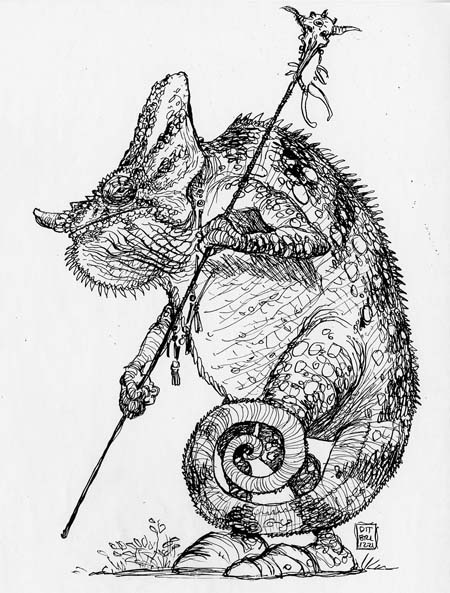
The Sarcophagus of Wim - Wim was the name of one of the Reptal kings that the Harmalan Warlocks dealt with.  The Reptals were a race of lizard men, from another plane of existence, that were often visited by the Warlocks, and in turn visited the Valley of the Old Ones.
Reptal (from Tony DiTerlizzi's page at http://diterlizzi.com/home/category/gaming-stuff/page/2/

Wim (pictured) was, according to his story, a King in his own country, yet in the world of the Valley of the Old Ones, he was content to remain alone (apart from his own kind), and to occasionally share stories with humans for interest and friendship.  During his extremely long life, towards the end, he befriended the Harmalans, and during his last decades constructed the stone sarcophagus he referred to as the Sleep Forge of Life.  It appears as a marble (with platinum bands throughout) block, big enough so that the top has a full six foot tall depression carved out for Wim, as he was when he died.  The whole block emanates magic.
If someone lays in the depression, they immediately go into a deep and restful trance, and their body begins to heal, at an extremely increased pace.  Full recovery of 3d6 hit points per 8 hour period is possible with the Sarcophagus of Wim.

Kavooty's Magical Spout - A large, ornate, three tiered fountain made of a giant central pedestal, and topped with three consecutive basins.  The top consists of a gold figurine of a tightly bound mermaid, with her head turned up, and a water jet bubbling up out of her mouth.  The pedestal itself is four feet across, constructed of an unidentifiable blue stone, inlaid with bands of gold.  The lowest basin extends out 2 feet in all directions from the basin, making it 8 feet across.  The basin is made of a thin layer of giant oyster shell, pink in color, but radiating a glow from the magic within it.  The second and third basins are progressively smaller, as is the pedestal supporting them, with the top (third) basin being itself only 4 feet across, with a 2 foot pedestal, upon which rests the spouting, bound mermaid statue.  The fountain is completely magical, and drinking from any of the three basins will confer different effects.  The topmost basin will, if it is sampled from, cause the drinker to make a saving throw vs. magic.  If successful, then the drinker will be conferred on with the health and lifespan of an elf.  If the drinker is already an elf, or if the saving throw is not made, then the drink is poisonous.  The drinker immediately takes 2d6 damage and becomes cursed with a horrible, non-stop, noisy and extremely unpleasant flatulence.  A cure disease (or being immune to disease) will negate the effect. The second basin will will turn normal, non-magical metal objects on the body of the drinker, into solid gold objects.  This effect only works once per day, and only works once in an individual's lifetime.  Example: Drogo takes a drink, and all the metal bits on him (weapons, armor, belt buckle, etc) all turn into gold.  It will never work for Drogo again, but if he and his party wait 24 hours, then one of his companions can attempt the drink.  The third basin will immediately begin smoking and bubling, and the whole pedestal will shake and shudder, once the water is drunk from.  After a round of this disconcerting behavior, out of the pool will spring 1d4+1 trolls, to attack whomever drank from the fountain.  The fountain was built by Doolar Kavooty, and he originally intended there to be a random sequence of effects from the fountain, but was killed by trolls before he complete the ensorcelment.

May 23, 2012

Storm King Barbarians

Before the three Goddesses were worshiped by the Westroners.  Before even the Westroners came into the valley, the northern peoples (all those north of the Great River) knew and worshiped Bronc, the Storm King.  He is an old deity, who was even known by the Old Ones, but the details of the relationship are not known these days.

The peoples who, since long ago, have remained true to the Storm King culture are divided up into tribes.  There are an unknown number of tribes across the northern frontier of the Destriel Mountains, however there is a concentration of various powerful tribes in and around the lands between the Great Owl Forest and the Shadow Woods.  This includes along the shores of the Greywater River, and also the Terrapin River.  The tribesmen are found throughout the region, however, due to the strong emphasis placed in the culture to go a-viking (raids for booty and adventure).

The tribes in the regions around the Greywater are in some ways rivals of the Westron Baronies, at least how they existed hundreds of years ago, when they were first formed.  There are a variety of the tribes in this area strong enough and numerous enough to have formed (small) cities.  These cities are walled wooden structures, usually with a deep moat around the outer wall.  Many of the Jarls who rule these cities are wealthy enough that they can field sizable fleets of dragon ships along the Greywater and Terrapin rivers.
 Because of the concentration of tribesmen that settle in and around these cities, there is actually a reasonably well defined economy, with all variety of specialty craftsmen.  Because of this, the military technology available to not only the huscarls and fyrdmen, but also to freebooters and adventurers nearly rivals that of the Westron Baronies.  Storm King barbarians disdain, as a whole, armor heavier than chainmail, and also the use of the pike and of the crossbow.  Preferred weapons are the sling, javelin and bow for ranged combat, and the broadsword and battleaxe for hand-to-hand combat.

In addition to the cities of the more powerful tribes, there are numerous smaller villages dotting the region. Many of these are peopled primarily by a single tribe, to also include those that marry in (either by arrangement, or as the result of viking raids).  These tribes are also protected wooden affairs, with wooden buildings, and occasionally (when built along either a main river, or a navigable tributary) with slips for dragon ships, and other craft.  Many of these villages (almost all) are direct fiefdom holdings of the more powerful Jarls, and so owe fyrdmen - feudal warriors - to the Jarl whenever he has a need for them.  When they are NOT enfiefed to the Jarl the fyrdmen either take care of their own small land holdings (animals and crops) or are out on viking raids.
  While animals are used for labor and muscle power (both in transport, and agriculture), there is not a strong horse riding culture among the Storm King barbarians.  Other animals are domesticated, and occasionally ridden, and these include giant rams, wooly rhinos, bison, great bears, and even (occasionally) giant snowy owls from the Great Owl Forest.