Showing posts with label magic item. Show all posts

Apr 30, 2013

The Book of Zargo Zar the Sage

One of the artifacts that the archivists at Parn Tandalorn are most keenly interested in locating, and one which has so far totally eluded magical location attempts, is an ancient book of spells and lore concerning the Elemental Gods, by an Old One scholar named Zargo Zar the Sage.

The book was written by a wizened academic over many, many years.  It reads like a chronicle, but at times is hard to follow, because over the time it was being written, Zargo Zar was slowly going mad.  It details the growth of the Old Ones, hints at their origins (created by a forgotten entity, that the Sage refers to as "the Spirit of Man") and also the fascination that so many of them had with the Elemental Gods.


The few excerpts that have survived discuss spells to summon servitors of the Elemental Gods, and also spells to ward off them.  More often, these are referred to in carvings and remnants that are found in other Old One artifacts and documents.  One of the things that supposedly exists is the Lay of Ba'a Zarn - which is an epic poem talking about how Ba'a Zarn, the Builder, battled a powerful entity allied with the Earth Weaver.  The entity was named Corruption, and supposedly it was not able to be slain, but it was trapped, beneath the Great River.  The Archivists at Parn Tandalorn have debated, for many decades (centuries) whether this was figurative, or if the Great River (which was constructed by Ba'a Zarn the Builder) was really built as a prison for Corruption.  Without the book it is hard to know.

Another portion of the book, that supposedly survived, is the Sage talking about the Lord of Fire and his minions.  This has been mentioned, in (presumed) heiroglyphs carved on a tablet embedded into the side of the Altar of the Old Ones (in the far south of Bartaloo region), so although not much is known about the construction of Altar, the Book of Zargo Zar either was in existence before the Altar was built, or came about at around the same time.


Locating the book, or even part of it - excerpts, spells, poems - would make for an admirable gift to the Archivists, but it also might help to save the world.  The ancient book, the Earnish-Amantic has a number of items in it relating to the Lady of the Air (another of the Elemental gods).  These are all taken from, and reference, the book of Zargo Zar.

Sep 9, 2012

Dungeon Key - Web of Ostigaar (5)

This is the continuation of the dungeon that began in Web of Ostigaar (4) (map detail here).

Room descriptions  (rooms 11-20)

11.The Observatory - This room is full of all sorts of (mostly broken) metal implements and instruments useful for navigation, or the drawing of charts and maps.  The ceiling is home to a magical construct, the Star Portal of Oo'Zondra (described here).  Of note, in the etheric landscape visible in the Star Portal, there is a wrecked hull of a strange wooden ship, designed to travel amongs the moons, suns, and other astral bodies.  Spilling over the side of the wreck, and down into the room, at the rate of 1d3 every 10 rounds (1 turn), are Giant Scorpions (see standard stats here).  When the room is visited, there are already 5x of the Giant Scorpions in the room.  Toppled and ancient furniture clutters the outer edge of this room, with a round stain dais in the middle.  In the corner of the room, there is a large stuffed chair, covered in cobwebs, and with stuffing coming out of the cushions.  If the seat is rummaged through, there is a small box, with 2000gp worth of highly polished purple gemstones inside it.  The box is locked and trapped, however, and any attempt to handle it roughly (picking, smashing, etc) will result in 1d4 poison needles striking the offender.  Each of these will do 1d6+1 damage, save for half.

12. The Cistern - This room consists of a spiral staircase that descends, with the outer edge against rock, and the inner edge open, down 60' to a pool of water.  Disturbing the water in any way will bring on the attack of an 8hd Giant Sea Snake (see standard stats here).  Down inside the cistern itself, it is 30 feet deep.  At the bottom is the skeleton of a dead ogre.  He is holding a giant golden key in his hand, which weighs 80 pounds.  This could be difficult to lift up through 30 feet of water.  If the key does break the surface of the water, it causes a 5d6 lightning bolt to shoot around in the room.  All must make a save vs. breath weapon to avoid being hit.  If one IS struck, then save vs. spell to avoid half damage.

13. Shrine of the Reptal - This room is dominated by two features.  The first is a large stone sarcophagus, in the eastern part of the room.  It is a large diamond shaped stone sarcophagus, with an outline carved in the top of a curious reptile-man type figure, with a chameleon head and tail.  This is a Reptal, and the sarcophagus is the magical construct, the "Sarcophagus of Wim" (detailed earlier).  In the western part of the room is a very large grating on the floor, that leads to a drop shaft that goes down some 60 feet to a chamber of water, contains three greater Filth Prawns (detailed earlier).  At the bottom of the pool is a sealed stone urn that contains a bag of holding (empty).
In the room, ready to engage the characters should they enter, are a Dark Elf Captain (she is named "Sidlar U'Zella") and 8 Dark Elf Warriors.  Sidlar U'Zella is wearing a curious necklace set with gemstones that glow different colors based on who is wearing it (worth 1000gp).  She also is in possession of several magical components, described earlier.  She has 1 dose of Revenant Lace, 1 dose of Cat's Paw, and 2 doses of Firecaps.  Upon entering combat, she will immediately take the Revenant Lace and the Cat's Paw, rendering her invisible and able to climb walls.  She is completely dedicated to the Artaxil Coven, and will fight to the death.
The Dark Elf Warriors have, on average, 200gp worth of jewelry each.  Among the group there is a potion of healing, and a potion of extra healing.
All of the Dark Elves - Captain and Warriors - are capable of spell use.
The Dark Elf group has with it a strange chest, bound in iron straps.  The straps are held by a strange stone disc (about 2" across) with a spider on it.  It is thin, and must be smashed to release the iron straps and open the chest.  Once the disc is smashed, if it is not by an Artaxil Dark Elf, it will summon 4 Stone Spiders to attack those who are attempting to open the chest.  Inside the chest are 5000gp worth of gems and also an ioun stone that grants the bearer the ability to cast Faerie Fire once per hour.

14. The Charred Room - This room was once adorned with fantastic tapestries of all types, covering the walls.  In the past, however, some conflagration burned up the major part of every tapestry.  Only charred remains are left hanging on the walls, and covering the floors.  The room is otherwise unfurnished.  In the room, however, are five large skeletal ogres (ac4, 30hp, thac014, 2 attacks (1d8+3 each), piercing and slashing weapons do half damage).  These can be turned by a member of clergy typically able to do so, but treat the skeletal ogres as 4th level undead for this purpose.

15. Meditation Rise - This room slopes up, at a steep angle, from north to south (the highest point).  At the southern end, there is a flat area, and there were once open grates in the ceiling opened up to the sky.  Since the layers of the city were built over this layer, that has closed up.  There is a dead body in the chair below the grate (a sort of throne like chair, but with no special material value or gems or anything out of the ordinary).  The body is unremarkable except for the (magical) gold band on the right arm.
As the players may want to ascend the steep ramp up to where the chair is with the dead body, they must climb.  It requires 3 checks in all, each check is of 1d20 trying to roll less than the dexterity of the checker.  Unfortunately, the whole way, a ghostly arm extending from the armband on the corpse, will attempt to attack the players using a ghostly long sword.  The long sword strikes twice per turn, with a thac0 of 11.  It will do 1d10+2 damage per strike.  The arm has an ac4, cannot be struck by non-magical weapons, and will take 24hp to diactivate.
The armband will summon the arm for whomever is wearing it, and it will be equipped with whatever weapon that person has in the arm of the arm band.  It will attack with that weapon, twice per round, with a +2 better than the wearer.  It will do damage +2.  The ghostly arm does not need to be concentrated on, but if the wielder loses consciousness it is disappears.  Deactivating it (by doing 24hp to it) results in the ghost arm being banished for 1d6 turns (10 min each).


16. This is a curious room.  First, to the east, there is a section of the room that is separated by a curtain.  The curtain is made of very heavy dark blue cloth, and there is a pale white glow coming out from under and on the sides of the curtain.  The rest of the room is full of dense clouds of steam.  The steam clouds are quite hot, and have peculiar properties that disrupts both infra and ultra vision.  Only normal sight works, and it is limited to approximately 10 feet in any one direction.  The only thing that can be made out upon entering from the northwest door or the south door is that there is a pale light coming through the mist from the eastern edge (the curtain).  In the floor, on the west, the floor all gathers down to a low point, with a grating, to allow any water gathered in the room (from the steam) to run out of the grating, down deep into an underground pool some 100' below.  Within the mists, in the western half of the room, there are lurking three blind trolls in the room.  They have learned a peculiar troll skill - blind fighting (typically trolls can regenerate lost eyes, but these for some reason cannot).  The trolls do not suffer negative effects in combat from the loss of eyesight, but they cannot make distinction between foes, and will always attack the nearest, regardless of the nature of that foe.
Behind the curtain is a large, glowing hot, pillar of stone.  It is 3' across the base, and 10' tall (the room ceiling in this room is approximately 12' tall, so the pillar does not go all the way to the ceiling).  The top and bottom of the pillar are encircled by a curious white metal.  The pillar is a magical construct, the Column of Fa'Tar (detailed earlier).  In the corners of the room, aimed at the column, are four hideous statues of feather covered gargoyles, each spitting a stream of water at the column, which explains the presence of the prodigious clouds of steam.  Curious note - if the gargoyles are removed from the wall in any way, they will continue to spit out a 15-20 foot stream of water, continuously, absent a dispel magic spell.

17. The Beating Room - This room was evidently originally designed to somehow separate people into groups, now it serves as hideous trap.  The two portcullis structures will come slamming down, as soon as they divide the party up into at least two groups.  At that point 6 filth prawns will be released into each section, and will attack whatever is there. 

18.The Shining Room - There is a curious white globe floating in the middle of the room that gives off enough light (30' radius) to dimly illuminate the entire room. The globe is weightless and can be moved.  It will continue to work.  In the room is a a large iron chest in the middle of the floor (near the globe, but apparently not related), which is locked.  Opening the lock will trigger a poison gas trap that will fill the room.  Make a d20 save vs. Constitution to see if breath can be held long enough to leave the room.  If passed, character immediately moves to the nearest door in panic, and crosses out of the room.  If failed, it means that they are stuck in the room, or didn't move fast enough, and suffer the effects of the gas (jittery and nauseous for 1 hour; lose 1d3 each from Strength, Dexterity, and Constitution; heal one random point back each day, cure disease will cure 1d3 points per day).  Beyond the gas trap, the iron chest has 3 platinum bars worth 1000gp each (very heavy, 40# each), and a magic broadsword (constructed by Storm King barbarians, a very long time ago), +2, with Ainark Runes that, if read, reveal (1) that the sword is named Nightfoe, and (2) if the name is uttered when the broadsword strikes the killing blow on an Intelligent foe, it transforms the body into 1d12 Death Birds.  If the wielder is of neutral or good alignment, the birds will remain for 2d12 rounds, attacking any foes that the wielder is an enemy of, but the shriek of the birds affects all in range;  if the wielder of the sword is rather of evil alignment, then the birds' shriek only affects the enemies of the wielder.
The inhabitants of the room are swirling schools of large toothy fish.  They will modestly avoid any characters, as they swim in seemingly meaningless patterns around the room.  If one is molested or attacked the fish immediately become hostile.  There are enough for 6 to attack each player.  They have the following stats:


Airacuda
Num Appearing: 5d6
Alignment: neutral
Movement: Swim (through air) 120'/round
Armor Class: 4 (hard metallic scales)
Hit Dice: 2hd
Attacks: Bite; if successful then automatically do bite damage per round until removed; if not successful, attempt a second Bite attack vs. same target.
Damage: 1d6+3
Save: F2
Morale: 9


19. Mantis Room - Five Thri-Kreen (see stats here) have taken up residence in here.  The grating over the floor opening (the whole room slopes down to this opening) has been pushed aside, and the Thri-Kreen have obviously climbed up out of the deep shaft, that 60' down opens up into underground cisterns.  The Thri-Kreen have a side cave, leading to a compound of their nest/hive; it is down about 30' in the shaft.  One of the mantis-men has a strange pot hanging around his neck, it is obviously very expensive, but not of Thri-Kreen manufacture.  If the party somehow enters the cave  that the nest/hive of the Thri-Kreen are from, they will find an ancient burial crypt, with a half dozen of sarcophagi, each having 3 or 4 of the very expensive pots arranged on it.  Each pot (there are 20 in all) is worth 1000gp.  In the room, however, there are 3 mummies (see stats here) that will work to defend the pots against any warm blooded invaders.

20. Copper Room - The walls of this room are lined in copper, and there are strange astronomical symbols etched on them in acid.  The copper is untarnished and highly polished.  Standing the middle of the room are two tall stone humanoids, with wings wrapped around them, and covering their face.  Touching either the statues or the copper will awaken the two Gargoyles (see stats here) that will attack fiercely and without hesitation.


Aug 27, 2012

Magical Constructs in the Web of Ostigaar (3 of 3)

The final installment describing the magical constructs that were once employed by the Harmalan sorcerers (and are now features in the Harmalan ruins that make up the dungeon of the Web of Ostigaar adventure) includes three features.  This article follows on the earlier part one and part two, in providing description of the multiple magical constructs and features that the Harmalan Sorcerers left behind them.  Note that creatures mentioned, as usual, are based on stats given in the Monster Statblock Reference.  These are basically 1st edition AD&D monster stats, made generic for a multitude of OSR rules.

The Enchanted Portico of Derwa te Tale is a curious item that is a closed over portico, almost like a large gazebo, made of gold and unidentifiable gemstones, and it allows a passage between the realms of air and water.  The Ice Chandelier is a curious chandelier, not made of ice (it is constructed, apparently, of platinum and diamonds) but emanating a magical field of cold, with curious properties.  And finally, the Mosaic of Dhuul is a tiele inlaid floor that has a pattern, which if walked, will grant specific magical gifts to the user.

All of these items, as all of those constructed for the Harmalan Sorcerers, have some risk of harm or personal cost associated with their use (or misuse).  [This is part of the feel of the Valley of the Old Ones campaign - magic, other than the spells a spell caster normally employs, should be mysterious, and should have a certain risk associated with its use.]

Enchanted Portico of Derwa te Tale - This object is a very large structure, similar to a gazebo - there is a broad floor, outer columns, and a ceiling/roof covering the whole structure.  It is constructed out of gold, and set with unidentifiable gemstones.  The gold pillars have alternating carvings of birds and fish.  This object is actually one of a pair of identical objects.  One is normally placed on dry land, and one underwater - the locations being chosen by the user as somewhere particularly interesting, and deserving of being linked together.  Beings inside either one of the objects have concurrent awareness of what is going on in and around both at one time.  Also, those beings exist in both places at the same time.  If a person were to walk into the one on dry land, they would also exist inside the space of the one underwater.  While inside the Portico, the visitor is able to breathe and function normally (for them) in both environs simultaneously.  So, while a person might be able to walk and breathe both in the dry land portico, and also in the one undersea - a mermaid would be able to swim and breathe in the one underwater, as well as the one on dry land.  Once, when someone first enters the Portico, they must make a saving throw vs. spells.  If it is passed, then there is no effect, although a new saving throw must be made each turn (10 rounds) that they remain within the portico.  If the save is failed, the person loses consciousness immediately, and must make a second save to also avoid losing a point of intelligence.  This is all due to the mental overload of having full consciousness of two different realities simultaneously.  The portico is named for the original inventor, Derwa te Tale - who loved an apprentice of his, but she was a were shark.  The portico was the means by which he carried on the love affair, until she went somewhat native, and a protective bull shark ate Derwa.

Ice Chandelier - This object consists of an ornate and elaborate Chandelier - the type used to provide light within a great keep's hall - made of platinum and diamonds.  Once it is installed in a room, it will begin to chill that room, down to an incredibly cold temperature, and frost and swirling snow will become a permanent feature of the space the Chandelier is installed in.  The magical cold and swirling snows and winds are of such a nature that they have a strong effect on all in the room.  First, anyone with a resistance to cold or cold based attacks, loses that resistance while in the room (if this is from an item - such as a ring, or boots, etc - then the item retains its power, it just "shuts off" while in the room).  Second, there are no saving throws allowed vs any cold or frost magic.  All such spells will have their maximum effect while in the space of the Chandelier.  Finally, once per turn, a small group of winter wolves (1d3+1) will pass through the region that the Chandelier is affecting.  If anyone is in the space, the winter wolves will attack.  A new group will pass through once every turn (10 rounds).

Mosaic of Dhuul - The mosaic is a large tile maze, that covers an entire floor within the room where it is constructed.  It consists of a mystical mandala, which if traversed will actually temporarily transport the person entering the maze into an alternate dimension.  Note that good clerics and paladins may not traverse the Mosaic - it has no effect and will not work for them.  The traveler that is tracing the mosaic will be in a trance-like sleepwalking state during a period of time of 1 turn (10 rounds).  At the end of which, they are (astrally) in another place.  Dhuul who constructed the Mosaic originally, was a secret worshipper of Dralizar, the night fox.  The mosaic leads to his realm, which appears as a vast desert of black and blue shadow, with a single white orb in the sky, illuminating the landscape with a harsh blue-ish white light.  The traveler will be stuck on the plane for some indeterminate period of time, and then will be attacked by a Grue appearing out of the night.  The type of grue will be random, but attacks with surprise.


dice grue type
1 Chaggrin (soil beast)
2 Harginn (flame horror)
3 Ildriss (wind terror)
4 Varrdig (fluid brute)

The traveler must do combat with the grue that attacks out of the dark, and may not use spells.  If the traveler wins, they have successfully traversed the Mosaic and may claim the prize (below).  If the traveler fails, they permanent lose a level, but suffer no other immediate effects (all hit points are restored).  In either case, the traveler finds them self back in on the floor of the mosaic, unconscious but otherwise unharmed (except, possibly, for the loss of level).

A successful traveler gains the ability to cast telepathic bond, once per day, regardless of their own class (i.e. even successful fighters and thieves can gain this ability).  The ability will not be able to bond with good clerics or paladins.

A failed traveler, other than losing a level, will now forever be hunted by grues.  At any time that the traveler finds themselves in a very dark place, there is a 10% chance that a random grue will appear and attack, with surprise, the character.  This hunting can only be stopped by a remove curse spell.


Aug 26, 2012

Magical Constructs in the Web of Ostigaar (2 of 3)

This is the second part of the series begun in part one.  These constructs will appear in the dungeon rooms of the Web of Ostigaar adventure, but are being presented here (separately) for use in other adventures, as well.

The next sequence of magical constructs features (again) three items.  The first is  the Pool of Seeing, the second is the Bleeding Cage of Viyatus, and the third is the Column of Fa'Tar.

The Pool of Seeing - This is a magical pool that draws together a sharp focus between the living, the dead, and the undead.  It is used, theoretically, as a focus for "speak with dead" spells, granting the caster some special allowances.  It basically adds three levels to the casting cleric's level, and some other benefits.  The chief benefit, however, is that as long as the deceased was known to the cleric, or some person at hand during the casting, then no remains of the deceased are necessary - if the spell is cast in the vicinity of the Pool of Seeing.
Caster
Level
Length of time
since Death
Duration of
Spell
Number of
Questions
5
1 week
2 rounds
3
6
1 month
6 rounds
4
7-9
1 year
2 turns
5
10-12
10 years
4 turns
6
13-17
100 years
6 turns
1 hour
8
18+
1,000 years
12 turns
2 hours
10

Now, for the cost. If contact is made with the pool, then it will immediately summon 1d4+1 wraiths that will attack whomever made contact with the pool, and all those in their company.

Bleeding Cage of Viyatus - This infernal creation was created by an evil sorceror, forced to work under magical geas for the Harmalan family, as a device to aid them in their own war against diabolical creatures.  The construct appears as a pair of large stone niches, each with a hinged metal door closing over them.  The one on the left always appears to be slick with a coating of blood.  The one on the right is clean and dry.  If the intended recipient of the "benefits" of the spell enters the chamber on the right, and a suitable victim is placed in the chamber on the left (the morally questionable Harmalan sorcerors employed prisoners and captured cultists that served the diabolical powers they were making war against), then the magic of the construct activates.  The sacrifice on the left is bled dry over the time of an hour, and the during that time, any extraordinary traits that the victim might have are passed to the recipient.  In this case extraordinary traits are defined as any ability that the victim might have that the recipient does not have.  This includes (and is mostly intended for) racial abilities.  It does not include class skills, magical talent (but innate magical abilities do count), or non-weapon proficiencies.  The victim is dead. The recipient retains the abilities for a time equal to their own constitution in days.  The cost of using this construct?  It causes horrible, horrible visions and nightmares.  Any spellcaster that uses the device will not be able to regain spells (either MU or Cleric) due to an inability to concentrate, for a period of time equal to how long they have their temporary abilities.  In addition, at the end of the period, a saving throw vs. Poison must be made, or the recipient suffers a permanent loss of (randomize) either Intelligence or Wisdom.  At the time of its construction, the evil sorceror Viyatus was forced to construct the Bleeding Cage, so that the Harmalan Sorcerors could benefit from the abilities they faced in the dark elf, and mind flayer, enemies they were warring against.

Column of Fa'Tar - There was once, in another dimension that could be visited only by magic, a city of Fa'Tar inhabited by curious three armed beings that served a mighty fire elementalist. The elementalist had a cadre of magical assistants and lieutenants known as the Flying Warlocks of Fa'Tar.  The means by which these Warlocks were able to fly was through use of the Column of Fa'Tar.  Now the column exists within the world of the Valley of the Old Ones.  It is a large (10' tall, 3' across at the base) pillar of highly polished stone, with massive bands of platinum at the base and top.  The column always is glowing, and even humming with heat, as it is constantly white hot.  Through magical means the platinum bands around the top and the base do not burn, nor do they get hot.  The column, if touched, will confer magical abilities on the one touching it.  However, the extreme heat of the surface will render the limb that touches the column as completely burnt, withered, and useless.  As a side effect of losing the limb, the toucher also suffers 3d6 hp loss.  In addition, for each touch, the character must make a save vs. paralyzation or suffer a permanent loss of 1 point of constitution.  For the first touch, the touching character gains the ability to levitate, up to 1 hour at a time, three times a day.  For the second touch (which requires the sacrificial abandonment of another limb), the toucher sprouts very large feathered wings, and can now fly for up to 1 hour at a time, up to three hours a day (this replaces the levitate ability).  The wings have a 20' wing span, however.  For the third touch, the wings are lost, and the touching agent now gets to fly, at will.  The limbs lost will not recover normally.  Nor will the hit points that they cost come back, until the limbs ARE recovered.  The method to recover the limbs is by a remove curse spell (one per limb), and then heal back the 3d6 hp loss, per limb, as the time to grow the withered part back.

Aug 24, 2012

Magical Constructs in the Web of Ostigaar (1 of 3)

There are several Magical Constructs, that is large features with magical properties, that not the typical magic item that can be easily carried around (such as a wand, ring, sword or boots).  These are unique magical items that were constructed by the Harmalan Warlocks during the age when that family wielded power.

Star Portal of Oo'Zondra - The warlock Oo'Zondra was thoroughly fascinated with not only the astral plane, but also the celestial motion of the various bodies that were propelled by the gods through the ether around the world.  To further aid him in his study of this aspect of reality, and its ability to assist with contacting the astral plane, the warlock constructed his star portal.  It is a simply a hole in the sky, but the otherside of the hole is what makes it interesting.  The hole was placed, eventually, up against the stone ceiling in a chamber, now part of the dungeons making up this adventure.  It is a permanent opening, although the air that is needed to breath by people stays on one side of the portal, and the stellar-fluous ether remains on the other side.  The three moons (the three goddesses) can be seen moving by, and sometimes even stopping to peer through the portal.  The various dark spheres above the moons (outside of their gaze, and home to the nephilim of Noxecatt) are sometimes visible, but gazing is not recommended, as it sometimes draws down one or more of the nephilim (also called star giants). A magic user spending time (one week) meditating and studying the stellar glories within the portal, will gain 1 point of intelligence.  In addition, their new-found understanding of the intricacies of magic allow them to learn a new spell (of the DM's choice), and also to re-roll for learning any spells lost to them (due to missed "chance to know spell" dice rolls) of their highest spell level.  However, a saving throw vs. magic must be made, once per day during the week, or they will attract powerful, and dangerous, creatures that traverse such dimensions.  This includes creatures such as Mind Flayers, Githyanki, certain Elementals, the Nephilim of Noxecatt, Slaads, Intellect Devourers and other horrors.  In addition, once the week of study begins, if it is interrupted for any reason (including being rendered unconscious at all during the week - normal sleep can and will be avoided without penalty during this time), then the magic user making the study will suffer a cosmic backlash, and permanently lose 1 point of intelligence.  Once this is done, the magic user will have a completely overpowering and unnatural fear of the portal, and of related creatures (such as those mentioned, and others).  A Remove Curse spell will alleviate this unnatural fear, but not restore the lost Intelligence.

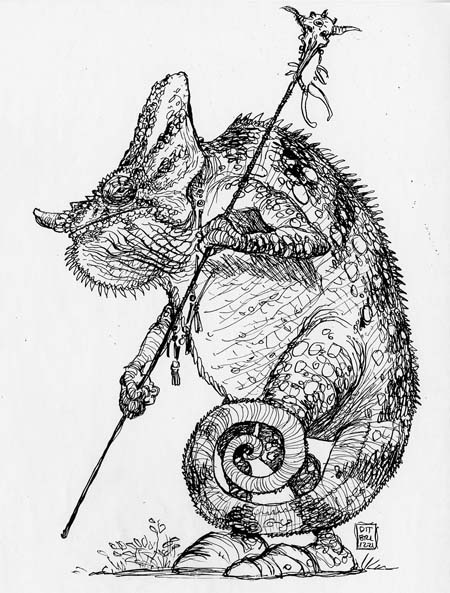
The Sarcophagus of Wim - Wim was the name of one of the Reptal kings that the Harmalan Warlocks dealt with.  The Reptals were a race of lizard men, from another plane of existence, that were often visited by the Warlocks, and in turn visited the Valley of the Old Ones.
Reptal (from Tony DiTerlizzi's page at http://diterlizzi.com/home/category/gaming-stuff/page/2/

Wim (pictured) was, according to his story, a King in his own country, yet in the world of the Valley of the Old Ones, he was content to remain alone (apart from his own kind), and to occasionally share stories with humans for interest and friendship.  During his extremely long life, towards the end, he befriended the Harmalans, and during his last decades constructed the stone sarcophagus he referred to as the Sleep Forge of Life.  It appears as a marble (with platinum bands throughout) block, big enough so that the top has a full six foot tall depression carved out for Wim, as he was when he died.  The whole block emanates magic.
If someone lays in the depression, they immediately go into a deep and restful trance, and their body begins to heal, at an extremely increased pace.  Full recovery of 3d6 hit points per 8 hour period is possible with the Sarcophagus of Wim.

Kavooty's Magical Spout - A large, ornate, three tiered fountain made of a giant central pedestal, and topped with three consecutive basins.  The top consists of a gold figurine of a tightly bound mermaid, with her head turned up, and a water jet bubbling up out of her mouth.  The pedestal itself is four feet across, constructed of an unidentifiable blue stone, inlaid with bands of gold.  The lowest basin extends out 2 feet in all directions from the basin, making it 8 feet across.  The basin is made of a thin layer of giant oyster shell, pink in color, but radiating a glow from the magic within it.  The second and third basins are progressively smaller, as is the pedestal supporting them, with the top (third) basin being itself only 4 feet across, with a 2 foot pedestal, upon which rests the spouting, bound mermaid statue.  The fountain is completely magical, and drinking from any of the three basins will confer different effects.  The topmost basin will, if it is sampled from, cause the drinker to make a saving throw vs. magic.  If successful, then the drinker will be conferred on with the health and lifespan of an elf.  If the drinker is already an elf, or if the saving throw is not made, then the drink is poisonous.  The drinker immediately takes 2d6 damage and becomes cursed with a horrible, non-stop, noisy and extremely unpleasant flatulence.  A cure disease (or being immune to disease) will negate the effect. The second basin will will turn normal, non-magical metal objects on the body of the drinker, into solid gold objects.  This effect only works once per day, and only works once in an individual's lifetime.  Example: Drogo takes a drink, and all the metal bits on him (weapons, armor, belt buckle, etc) all turn into gold.  It will never work for Drogo again, but if he and his party wait 24 hours, then one of his companions can attempt the drink.  The third basin will immediately begin smoking and bubling, and the whole pedestal will shake and shudder, once the water is drunk from.  After a round of this disconcerting behavior, out of the pool will spring 1d4+1 trolls, to attack whomever drank from the fountain.  The fountain was built by Doolar Kavooty, and he originally intended there to be a random sequence of effects from the fountain, but was killed by trolls before he complete the ensorcelment.

Jul 2, 2012

Shadow Cultists - encounter from Cult of the White Shadow

One of the final remaining encounters mentioned in the Cult of the White Shadow adventure are the Cultists themselves.  These are a varied group of deranged individuals, whom have decided to follow the madness of the cult, at one level of dedication or another.

Membership comes from a nomination, which to be accepted, must be from an individual who has renounced the established Westroner religions, and whom has dedicated him/her self to the path of following the cult's pursuit of knowledge about the White Shadow, the Shadow Wyrms, and the originator of Shadow, the Lady of the Air.

A nominant must serve, as such, for a period of at least one year.  During that time, they are requested to perform more and more horrible acts, which are intended to make life difficult for those around them not of the cult, and also to forward the campaign of fear and terror that the cult pursues.

After a year, the nominant can present them self for recognition as a cultist.  They must have performed some horrible deed, which then can brag about at a council of local elders, in order to impress them for membership.

There are several levels of cultists - from the lowly simple thugs (called the despised), on up through the warrior types (called swords of the shadow), mission leadership (called the mind of the shadow), assassins (claws of the shadow), priests/priestesses (fist of the shadow), and sorcerers (flame of the shadow).  All are chaotic neutral, and all can vary in level, although the despised typically are not above 3rd level.

While doing the business of their cult, all cultists are robed in simple grey robes.


The Despised
Num Appearing: 2d6 (or as a mission master from the Cult decrees)
Alignment: chaotic evil
Movement: Walk 90'
Armor Class: 5
Hit Dice: 2d (12 h.p.)
Attacks: 1 (trademark spiky flail)
Damage: 1d8+2
Save: T2
Morale: 8
Treasure: None, other than mission related.  Individuals - 2d6 GP each.
Special: Usually none, other than special magical conditioning which gives a +2 on all saving throws.  Occasionally, some of The Despised will be given the Food of the Shadow (see below).  An individual member of The Despised is called only Scum, and accompanied by a number.  By vow and oath, the Despised are not allowed to speak, and often have vile, filthy rags tied around their mouths.


There are times when a mission calls for better trained members of the cult than The Despised.  In those instances they are often warriors known as the Swords of the Shadow.  These are lead by leaders known as the Mind of the Shadow.  There will never be more than one Mind of the Shadow on a single mission, regardless of what other types of cultists are present.


Swords of the Shadow
Num Appearing: 1d6
Alignment:  chaotic evil
Movement: Walk 90'
Armor Class: 3
Hit Dice: 4d (36 h.p.)
Attacks: 3 attacks every 2 rounds, Broadsword (specialized)
Damage: 2d4+4
Save: F4
Morale: 10
Treasure: None.  Occasionally, a magic item for the leader of the group.
Special: Swords of the Shadow are human warriors, specialized in the use of the broadsword (THAC0 13).  They will occasionally also carry darts (standard), and these may be poisoned with a burning blood poison (save vs. poison, or take 1d6 per round, for three rounds and a -2 to hit during those three rounds).


The Swords of the Shadow are lead by the blind masters known as the Mind of the Shadow.  Such a leader leads via mental awareness and telepathy, which are the result of long and torturous treatments of dedicated sorcerers.  They lose both their eyesight, and the ability to cast spells, in return for mental gifts the cult bestows on them.


Mind of the Shadow
Num Appearing: 1
Alignment: chaotic evil
Movement: Walk 90'
Armor Class: 8
Hit Dice: 4-8 d4 (number varies)
Attacks: 1 knife; 1 mind blast
Damage: Knife does 1d4, mind blast does 2d6 (see special)
Save: MU4-8
Morale: 10
Treasure: Doses of Food of the Shadow (see below).
Special: The mind blast of the Mind of the Shadow has no effect at all on any type of fey creature, elf or otherwise.  It does affect the intelligent much more than those less gifted in that area.  Apply as a bonus to the damage, the number of additional languages that the target is able to learn.
The Mind of the Shadow is completely blind, but is in constant communication with any Swords of the Shadow or Despised under it's command.  It itself is not affected by being in the dark, or other adverse visibility conditions (including being attacked from the flank or rear), and halves the negatives applied to those it controls.
A party controlled by a Mind of the Shadow is never surprised.


Finally, there are assassins (Claws of the Shadow), priests (Fist of the Shadow), and sorcerers (Flame of the Shadow) but each of these is an individual of reasonably high level (near title level, for their profession) who have, for whatever reason, turned to service of the Cult.  They are each treated as individuals, and as such, would not come under control of a Mind of the Shadow.

The magical food of the shadow is an item that will sometimes be in possession of either The Despised (rarely), or more likely the Swords of the Shadow or a Mind of the Shadow.  It is usually known what doses are present, but in the case that it is not recorded, or in a random encounter, the doses can be diced for.  See below for a description of the effects of this item.


Food of the Shadow (magic item)
The food of the shadow refers to a number of different items. prepared from the magical leavings of shadow creatures, which they exude when absent from the Shadow Dimension for too long.  These leavings are gathered up by select members of The Despised, and prepared according to certain magical formulae, and result in hard small wafers, which may be consumed.  Once done so, a roll on the following chart (1d8) is made (unless the type is known before hand, according to the scenario) to determine the effects.  All effects last for only 2d12 rounds.
  1. Burst into flames - all within weapon's reach of the cultist are singed for 2d4 damage, and must make a save vs. breath weapon each round, to avoid catching fire.  If they catch fire, it burns for 2d6 the first round, and 1d6 for each additional round until it is extinguished.
  2. Fly - the cultist is able to fly, at a speed of 120' per minute.
  3. Iron Skin - the cultist assumes the density and hardness of tough iron.  Armor Class 1.
  4. Become the Shadow - the cultist wisps out into a shadowy form, and then disappears altogether.
  5. Transformation - the cultist becomes a Shadow Creature.  This effect does not wear off, but is permanent.
  6. Legion - the cultist sprouts 4 additional copies of him/her self.
  7. Essence of Acid - the cultist's bodily fluids become a horrible acid.  Any combat blows against the cultist will result in a rain of acid to all within a 10' radius.  All take 2d4 damage, and an additional 1d4 for each of the next two rounds.  A successful save vs. poison will halve the damage.
  8. Devoted Spirit - the cultist is affect as if by a haste spell.