In the current era of the Valley (year 1534 since the Westerner Migrations first began out of the Olmart Empire, so it is marked 1534WM), each of the various Baronies is ruled over by a regent of some sort. Most of these are Barons, at least in the nomenclature of the Kingdom of Ymnaris. The Kingdom was first established, in the year 26 when the First City was settled (now often called Hogle). The capitol of the Kingdom moved progressively eastward with successive generations and waves of migration. Each of the four fiefdoms that originally housed a capitol city of Ymnaris is entitled to the title Duke for their ruler, however they are still commonly referred to as Baronies. Up until the Neill family assumed the throne of the Kingdom of Ymnaris, several generations back. the ruler of the kingdom was referred to as the Archduke, however with the growing separation from the Olmart Empire, this title was dropped, and the title of King (or Queen) has been in use now, by the Neills at least, for the past 352 years (since year 1182).
Rulers of the Westron Baronies
Hogle - Duke Keevar Silverhand (m, age 54), settled year 26. Capitol of Kingdom of Ymnaris from the year 26 until 165.
Macester - Baron Tyremius Ap Troft of Trofthall (m, age 162), settled year 82.
Ockham - Baron Guiscar the Enlightened (m, age 47), settled year 107.
Scallen - Duchess Safeeny Everlight (f, age 53), settled year 163. Capitol of Kingdom of Ymnaris from 165 until 341.
Kof Karn - Baroness Talena Ap Ironheart (f, age 31), settled year 219.
Khomaes - Baron Aldra Ap Iaggio of Erthos (m, age 59), settled year 231. The city itself is ruled by a Proctor.
Henn - Baroness Lendara Astern (f, age 32), settled year 285.
Pellorix - Duke Falden the Just (m, age 51), settled year 341. Capitol of Kingdom of Ymnaris from 341 until 642.
Werms - Baron Kilgar Ap Huim, Ne Etro (m, age 45), settled year 352. The city itself is ruled by a Magistrate, typically a magic user (currently, a mysterious hooded person titled the Wizard of Werms).
Huygen - Baroness G'Melan Luce Ap Viellot (f, age 33), settld year 394.
Gorrem - Baroness Catherine Ap Terrasund of Tatelis, also called The Second (f, age 49), settled year 462.
Na Kram - Baron Farris Quar Nev of Borleos (m, age 73), settled year 558.
Lynch - Duchess Tindra Ap Logis of Oakforge (f, age 40), settled year 642. Capitol of Kingdom of Ymnaris from 642 until 1021.
Botts - Baron Pesar Ap Gansford of Tuldis (m, age 51), settled year 728
Ungams - Baron Virondis Pulchky (m, age 59) , settled year 902.
City of Narn - King (Archduke) Alasdair IV (m, age 37), settled year 914. Capitol of Kingdom of Ymnaris since 1021.
Devrie - Baron Huntain Dorren of Ymnar Hall, also called The Miner (m, age 51), settled year 1022.
Futtonol - Baron Rolan Ap Kopf of Kopfheim, settled year 1099.
Kennidor - Baron Hugh Voxely, of Lakecastle (m, age 39), settled year 1186.
A curious event occurred just over four hundred years ago. The gathering of Barons in the year 1015 had agreed that a new capitol for the Kingdom was needed, as the Tower-Keep of Oakforge (in the Barony of Lynch at the City of Fire) was under constant threat at the time by an army of chaos creatures out of the western Nel Nod forest. The new location was to be the new settlement forming between the Erando and Moa Thola rivers, which would become the City of Shale, and capitol of the Barony of Devrie. However, at the last, just before the Malachite Throne was to be transferred to the new site in 1021, a group of northern Barons made the case for transferring it to the city of Narn instead. Narn was previously not considered, because it was built on the site of a long dead city, taking advantage of the ruins that were there already when the Westroners came in 914, however it was thought to be a safer location, than another capitol in the wild south, where the Sun King Barbarians still threatened all of the settlements and cities.
The new location, at Narn, satisfied most, except for the southern Barons from Gorrem, Lynch, and Ungams, who have referred to Narn as the Shadow Capitol, and refer to Devrie as the Chosen Capitol. These tensions have spread to understandings and relations among the various eastern Baronies, but nothing has come to open war. With the passage of three centuries, the original animosity that accompanied the founding of Devrie, and the change of the Capitol from Devrie to Narn, has been mostly forgotten, but the establishment of alliances (however tenuous the reasoning) between the different groups of Baronies, has proven a strong motivation for mutual support, and trade, ever since.
Showing posts with label Botts. Show all posts
Showing posts with label Botts. Show all posts
Apr 20, 2013
Apr 8, 2013
Gof Annish - Tower of the Necromancer
There is a nearly barren heath, on the southeast border of the Craggy Hills, in the rough triangle formed by the Craggy Hills, the slopes of Fire Mountian, and the City of Botts, in the region of the Sildur Reaches. The heath is often referred to as Gof Annish, although the title refers, properly. to the strange, ancient tower at the center of the 10 mile heath.
The tower is ancient, built no doubt by the Old Ones. Today it is home to a mysterious figure known only as The Necromancer. The tower is peopled with all sorts of undead constructs and creations, and the immediate country side is not contested by anyone.
There is a nearby town (maybe half a day's walk) to the tower, but it is outside of the barren heath. The town is home to a small number of farming peasants who not only tend to their own needs, but also support the nearby monastery known as the Hove of Enlightenment. It is a place of meditation, study and reflection for a community of Kyclos, the consort of Nadene, the Goddess of Fertility. It seems that the Brothers of the order are quite fascinated with the difference between living and dead, and so have made a study of the undead creatures of Gof Annish. The inhabitants of the town know some of the following goings-on at the heath.
The heath itself is kept cursed and freed from most life (no animals live there, and very few plants, other than the Annish vine). This is done by the hand of the Necromancer and his serving hordes of undead. Twice a year, a massive procession of skeletons, led by 12 bone devils, lead the Bell of the Damned in a circle around the edge of the heath, three times, starting at midnight on the Equinox, and taking over three days. The circuit around the edge of the heath is over 30 miles, and the Bell itself is huge. It is a massively large bell, weighting thousands of pounds, and mounted in a tall (25') wooden scaffold, on wheels. Hundreds of skeletons, pulling on ropes and chains, heave the scaffolding out of the Tower of Gof Annish, out to the edge of the heath, and then begin their thrice encirclement of the lifeless land. During this parade of death, the bell is rung continually, and a faint unearthly moaning rises up from the skeletal mouths. The 12 bone devils at the head of the procession are shouting loud shrill blasphemies against life and the three Goddesses and will attack anything living in the path of the procession.
The only thing, above the level of lichens and short scrubby grass, that lives on the heath are the Annish vines. These are curious plants, appearing basically as large clumps of massive radial tubers, growing out of a common thick root. The tubers are some 30-40 feet long, and at their base some 8-10 inches around, tapering to only an inch or so across at the end. They react to the presence of life, and if encountered at any time during the year, may attack whatever creature comes near them (these are located, not thickly, but placed fairly randomly all across the heath. Since they tend to lay down, limp, in a radial splayed out pattern when they are not active, they are hard to spot until a traveler is somewhat close). During the procession of the Bell of the Damned, however, they come to life. The Annish Vines wave their horrid tubers in the air, violently and randomly, and unroot themselves. Somehow they can drag their root ball out across the surface of the ground, and will attempt to fall into place behind the procession, before settling down again. An active Annish Vine does not travel too fast, but then again neither does a horde of thousands of undead hauling on a bell that weighs thousands of pounds. The Vines, after following the procession for a short time, will return to a random spot on the heath, and take up root again.
Name: Annish Vines
No. Encountered: 1-3
Alignment: Chaotic Evil
Movement: 30'
Armor Class: 4
Hit Dice: 10 (65hp)
Attacks: Up to 16 (no more than 4 against any one man sized foe).
Damage: 1-12+2
Save: F10
Morale: 9
Hoard Class: VI
XP: 850
The Annish Vine has many fibrous tubers to attack with, but can not bring any more than 4 at a time against any one foe. It can, however, attack any foes within 30' of its base. The Treasure Hoard that it might have are items that are to be found in the ground, at the base of the root ball that the vines grow out of. These are the remains of any victims that have been slain and eaten previously.
The Annish Vine is immune to normal missile fire, but takes normal damage from fire and acid based attacks. Against magic, it has a 25% magic resistance, but has not concentrated mind so is immune to spells such as Sleep and Charm.
Occasionally, some group or another, typically Knights from the City of Air (Botts), or an order of Errant Paladins (such as the Paladins of the White Lady), will want to take up arms against the Procession, or even against the seat of power at Gof Annish tower itself. They have always been stopped in the past by both the Priests and Monks of Kyclos from the Hove of Enlightenment, or by members of the Silver order of Druids. Occasionally, in recent history, this has been by the Master of the Silver Order himself, from the Star Tower in the Aghanz Hills.
The tower is ancient, built no doubt by the Old Ones. Today it is home to a mysterious figure known only as The Necromancer. The tower is peopled with all sorts of undead constructs and creations, and the immediate country side is not contested by anyone.
There is a nearby town (maybe half a day's walk) to the tower, but it is outside of the barren heath. The town is home to a small number of farming peasants who not only tend to their own needs, but also support the nearby monastery known as the Hove of Enlightenment. It is a place of meditation, study and reflection for a community of Kyclos, the consort of Nadene, the Goddess of Fertility. It seems that the Brothers of the order are quite fascinated with the difference between living and dead, and so have made a study of the undead creatures of Gof Annish. The inhabitants of the town know some of the following goings-on at the heath.
The heath itself is kept cursed and freed from most life (no animals live there, and very few plants, other than the Annish vine). This is done by the hand of the Necromancer and his serving hordes of undead. Twice a year, a massive procession of skeletons, led by 12 bone devils, lead the Bell of the Damned in a circle around the edge of the heath, three times, starting at midnight on the Equinox, and taking over three days. The circuit around the edge of the heath is over 30 miles, and the Bell itself is huge. It is a massively large bell, weighting thousands of pounds, and mounted in a tall (25') wooden scaffold, on wheels. Hundreds of skeletons, pulling on ropes and chains, heave the scaffolding out of the Tower of Gof Annish, out to the edge of the heath, and then begin their thrice encirclement of the lifeless land. During this parade of death, the bell is rung continually, and a faint unearthly moaning rises up from the skeletal mouths. The 12 bone devils at the head of the procession are shouting loud shrill blasphemies against life and the three Goddesses and will attack anything living in the path of the procession.
 |
| Procession of the Damned from Gof Annish, around the cursed heath |
The only thing, above the level of lichens and short scrubby grass, that lives on the heath are the Annish vines. These are curious plants, appearing basically as large clumps of massive radial tubers, growing out of a common thick root. The tubers are some 30-40 feet long, and at their base some 8-10 inches around, tapering to only an inch or so across at the end. They react to the presence of life, and if encountered at any time during the year, may attack whatever creature comes near them (these are located, not thickly, but placed fairly randomly all across the heath. Since they tend to lay down, limp, in a radial splayed out pattern when they are not active, they are hard to spot until a traveler is somewhat close). During the procession of the Bell of the Damned, however, they come to life. The Annish Vines wave their horrid tubers in the air, violently and randomly, and unroot themselves. Somehow they can drag their root ball out across the surface of the ground, and will attempt to fall into place behind the procession, before settling down again. An active Annish Vine does not travel too fast, but then again neither does a horde of thousands of undead hauling on a bell that weighs thousands of pounds. The Vines, after following the procession for a short time, will return to a random spot on the heath, and take up root again.
Name: Annish Vines
No. Encountered: 1-3
Alignment: Chaotic Evil
Movement: 30'
Armor Class: 4
Hit Dice: 10 (65hp)
Attacks: Up to 16 (no more than 4 against any one man sized foe).
Damage: 1-12+2
Save: F10
Morale: 9
Hoard Class: VI
XP: 850
The Annish Vine has many fibrous tubers to attack with, but can not bring any more than 4 at a time against any one foe. It can, however, attack any foes within 30' of its base. The Treasure Hoard that it might have are items that are to be found in the ground, at the base of the root ball that the vines grow out of. These are the remains of any victims that have been slain and eaten previously.
The Annish Vine is immune to normal missile fire, but takes normal damage from fire and acid based attacks. Against magic, it has a 25% magic resistance, but has not concentrated mind so is immune to spells such as Sleep and Charm.
Occasionally, some group or another, typically Knights from the City of Air (Botts), or an order of Errant Paladins (such as the Paladins of the White Lady), will want to take up arms against the Procession, or even against the seat of power at Gof Annish tower itself. They have always been stopped in the past by both the Priests and Monks of Kyclos from the Hove of Enlightenment, or by members of the Silver order of Druids. Occasionally, in recent history, this has been by the Master of the Silver Order himself, from the Star Tower in the Aghanz Hills.
Apr 2, 2013
Baronies - The holdings of the Westroners in the Valley
There are currently 19 Westron Baronies in the Valley of the Old Ones. Technically speaking, there are 18 Baronies, and the city of Narn, which is the capitol of the Kingdom of Ymnaris - of which the 18 other Baronies are technically fiefdoms. However, in practice, Ymnaris (currently ruled by Duke Alasdair IV of the Neill family) is little more powerful than some of the other larger baronies. The two points of exception for Narn are its size (it is larger, by thousands of inhabitants, than the next largest Baronial city), and the fact that the Cathedral of St. Narn is there - for which the city is named. The Cathedral of St. Narn is also the seat of the Church (technically, the "High Office at St. Narn of the Westron Church of the Three Goddesses").
The Cities (which are technically named for the barony of which they are the capitol) all have their own "official" nick name. They were all settled between the years 26 and 1186. It is currently the year 1534 of the Western Migration, so the younger cities have only been established as short as 300 years since they were originally settled, compared to the oldest, which has been settled now for over 1500 years.
The population figures given are JUST for the City, and not for the whole Barony. In most cases, assume that the Barony will number this much again in dependent towns, and double this amount in dispersed rural communities.
So other than the city of Narn, the other 18 Baronies are as follows:
Hogle - "The First City" in the Shattered Plains region; pop. 18,000, settled year 26.
Macester - "City of the Sword" in the Gateway region; pop. 21,000, settled year 82.
Ockham - "City of Enchantment" in the Enchanted Forests region; pop. 19,000, settled year 107.
Scallen - "City of Birds" in the Bartaloo region; pop. 19,500, settled year 163.
Kof Karn - "City in the Cradle" in the Rising Land region; pop. 21,000, settled year 219.
Khomaes - "City of Mists"; in the Darkearth Plains region; pop. 22,000, settled year 231.
Henn - "City of the Shadows" in the Rising Land region; pop. 18,000, settled year 285.
Pellorix - "City of the Lake" in the Rising Land region; pop. 19,000, settled year 341.
Werms - "City in the Clouds" in the Darkearth Plains region; pop. 19,000, settled year 352.
Huygen - "City of Light" in the Darkearth Plains region; pop. 18,500, settled year 394.
Gorrem - "City of Ten Gates" in the Wychwood region; pop. 27,000,settled year 462.
Na Kram - "City of Dust", in the Sildur Reaches region; pop. 18,000, settled year 558.
Lynch - "City of Fire" in the Nightside region; pop. 20,000, settled year 642.
Botts - "City of Wind" in the Sildur Reaches region; pop. 17,500, settled year 728.
Ungams - "City of the Harp" in the Nightside region; pop. 16,000, settled year 902.
City of Narn - "City of the Three Goddesses" Capitol of Kingdom of Ymnaris; in the Suuviz region; pop. 38,000, settled year 914.
Devrie - "City of Shale" in the Shale March region; pop. 16,000, settled year 1022.
Futtonol - "The Shield City" in the Suuviz region; pop. 11,000, settled year 1099.
Kennidor - "City on the Frontier" in the Shale March region; pop. 12,500, settled year 1186.
Note that the nicknames of the city are those that the Archivists at Parn Tandalorn have decided to grant the city, in order to differentiate the City itself form the Barony, which often includes lands, villages, castles and other holdings far beyond the borders of the city. The local inhabitants, however, will sometimes choose a different name (either from custom, or predating the naming by the Archivists). For instance, the inhabitants of the First City (capitol of the Barony of Hogle) often refer to it as Granite Hold - which was the name of the Castle first built there by the founding baron, Sir Tuneyer of Ockett, in the year 26. It took him, and his men, a number of years to build Granite Hold, but they adopted for a stone structure from the start, hence the name.
The Cities (which are technically named for the barony of which they are the capitol) all have their own "official" nick name. They were all settled between the years 26 and 1186. It is currently the year 1534 of the Western Migration, so the younger cities have only been established as short as 300 years since they were originally settled, compared to the oldest, which has been settled now for over 1500 years.
The population figures given are JUST for the City, and not for the whole Barony. In most cases, assume that the Barony will number this much again in dependent towns, and double this amount in dispersed rural communities.
So other than the city of Narn, the other 18 Baronies are as follows:
Hogle - "The First City" in the Shattered Plains region; pop. 18,000, settled year 26.
Macester - "City of the Sword" in the Gateway region; pop. 21,000, settled year 82.
Ockham - "City of Enchantment" in the Enchanted Forests region; pop. 19,000, settled year 107.
Scallen - "City of Birds" in the Bartaloo region; pop. 19,500, settled year 163.
Kof Karn - "City in the Cradle" in the Rising Land region; pop. 21,000, settled year 219.
Khomaes - "City of Mists"; in the Darkearth Plains region; pop. 22,000, settled year 231.
Henn - "City of the Shadows" in the Rising Land region; pop. 18,000, settled year 285.
Pellorix - "City of the Lake" in the Rising Land region; pop. 19,000, settled year 341.
Werms - "City in the Clouds" in the Darkearth Plains region; pop. 19,000, settled year 352.
Huygen - "City of Light" in the Darkearth Plains region; pop. 18,500, settled year 394.
Gorrem - "City of Ten Gates" in the Wychwood region; pop. 27,000,settled year 462.
Na Kram - "City of Dust", in the Sildur Reaches region; pop. 18,000, settled year 558.
Lynch - "City of Fire" in the Nightside region; pop. 20,000, settled year 642.
Botts - "City of Wind" in the Sildur Reaches region; pop. 17,500, settled year 728.
Ungams - "City of the Harp" in the Nightside region; pop. 16,000, settled year 902.
City of Narn - "City of the Three Goddesses" Capitol of Kingdom of Ymnaris; in the Suuviz region; pop. 38,000, settled year 914.
Devrie - "City of Shale" in the Shale March region; pop. 16,000, settled year 1022.
Futtonol - "The Shield City" in the Suuviz region; pop. 11,000, settled year 1099.
Kennidor - "City on the Frontier" in the Shale March region; pop. 12,500, settled year 1186.
Note that the nicknames of the city are those that the Archivists at Parn Tandalorn have decided to grant the city, in order to differentiate the City itself form the Barony, which often includes lands, villages, castles and other holdings far beyond the borders of the city. The local inhabitants, however, will sometimes choose a different name (either from custom, or predating the naming by the Archivists). For instance, the inhabitants of the First City (capitol of the Barony of Hogle) often refer to it as Granite Hold - which was the name of the Castle first built there by the founding baron, Sir Tuneyer of Ockett, in the year 26. It took him, and his men, a number of years to build Granite Hold, but they adopted for a stone structure from the start, hence the name.
Mar 19, 2013
Regions of the Valley (4) - Sildur Reaches
[This is the introduction to the region of the Sildur Reaches, a mapping and some hex details have been posted already].
The Sildur Reaches describes the region of the valley that lies north of the Great River, south of the Destriel Mountains, and between the Fa'Ars River on the eastern border, and the Greywater River on the western border.
The central terrain of this region is dominated by the patchy pine forests that together make up the massive Shadow Woods. The pines of this region include the mighty Giant Cloudwood pine trees, that can reach as much as 400 feet tall, and as big around as 25-30 feet. Some Cloudwoods are as old as 2,500 or 3,000 years, according to some Wood Elf sages that have been tending them as a life project. Other pines in the area include the gnarleycone pine tree, the bristlecone pine tree and also the thinwhistle pine tree.
The whole region was once heavily, heavily forested, but it is believed that during the time of the Old Ones that it was deforested. The reason is unknown, but occasionally massive fields full of the stumps of Cloudwood trees are still encountered. These are often home to packs of dire wolves, giant badgers, and frequently swarms of giant burrowing insects (mostly giant beetles of different types, some as large as 10 or 12 feet long; and also a peculiar type of ground dwelling giant tick that are the bane of the dire wolves).
The name of the region, the Sildur Reaches, comes from the name of a Frost Giant warlord, or king as he preferred to be called, that ravaged the region during the time between the departure of the Old Ones and the arrival of the Westroners. Some of the incredible crusading campaigns waged by the early bands of Westron knights in this region were against the armies of Frost Giants, and their ogre and bugbear allies. Once the Giant Crusades were over, the Giants were confined to the mountainous lands to the north east, around the Tears of Heaven.
The road that extends from the city of Botts southwest to the city of Na Kram passes over the King's Highway. Actually it passes under the King's Highway, but it does so through an area that is a flooded bog. There is a vast tunnel through the mound of the Highway at this point, approximately 200 yards wide, and 30 yards high at the center, through which punt boat traffic frequently travels. This boat traffic is one of the activities of the swamp town of Wall Morton. This is a Westron town that is built all on pillars in the bog, and almost all movement in and around the town is by punt boat. The swamp itself, called simply The Morton is about 75 miles wide, but this is spotted throughout with islands and high areas where trees grow, but the region is generally boggy and covered in fetid waterways. A number of black dragons make their home here, and there is a order of Knights of the White Lady (paladins) who dwell in Wall Morton, and they patrol the region on the back of great hippogriffs.
In addition to the swamp town of Wall Morton, there are a number of other independent towns, that are not part of either the Barony of Botts or of the Barony of Na Kram. These are Willow (in the east, a river trading town on the Fa'Ars River), Gavaar and Roesen (two rival ports on the Great River), Jinette (trade town on the road between Na Kram and Huygen "The City of Lights" - which is across the Greywater River in the Darkearth Plains) and Haaksen (walled trade town on the road between Na Kram and Wall Morton).
The Sildur Reaches describes the region of the valley that lies north of the Great River, south of the Destriel Mountains, and between the Fa'Ars River on the eastern border, and the Greywater River on the western border.
The central terrain of this region is dominated by the patchy pine forests that together make up the massive Shadow Woods. The pines of this region include the mighty Giant Cloudwood pine trees, that can reach as much as 400 feet tall, and as big around as 25-30 feet. Some Cloudwoods are as old as 2,500 or 3,000 years, according to some Wood Elf sages that have been tending them as a life project. Other pines in the area include the gnarleycone pine tree, the bristlecone pine tree and also the thinwhistle pine tree.
The whole region was once heavily, heavily forested, but it is believed that during the time of the Old Ones that it was deforested. The reason is unknown, but occasionally massive fields full of the stumps of Cloudwood trees are still encountered. These are often home to packs of dire wolves, giant badgers, and frequently swarms of giant burrowing insects (mostly giant beetles of different types, some as large as 10 or 12 feet long; and also a peculiar type of ground dwelling giant tick that are the bane of the dire wolves).
The name of the region, the Sildur Reaches, comes from the name of a Frost Giant warlord, or king as he preferred to be called, that ravaged the region during the time between the departure of the Old Ones and the arrival of the Westroners. Some of the incredible crusading campaigns waged by the early bands of Westron knights in this region were against the armies of Frost Giants, and their ogre and bugbear allies. Once the Giant Crusades were over, the Giants were confined to the mountainous lands to the north east, around the Tears of Heaven.
The road that extends from the city of Botts southwest to the city of Na Kram passes over the King's Highway. Actually it passes under the King's Highway, but it does so through an area that is a flooded bog. There is a vast tunnel through the mound of the Highway at this point, approximately 200 yards wide, and 30 yards high at the center, through which punt boat traffic frequently travels. This boat traffic is one of the activities of the swamp town of Wall Morton. This is a Westron town that is built all on pillars in the bog, and almost all movement in and around the town is by punt boat. The swamp itself, called simply The Morton is about 75 miles wide, but this is spotted throughout with islands and high areas where trees grow, but the region is generally boggy and covered in fetid waterways. A number of black dragons make their home here, and there is a order of Knights of the White Lady (paladins) who dwell in Wall Morton, and they patrol the region on the back of great hippogriffs.
 |
| Paladin of the White Lady fighting a Black Dragon for a captured maiden. |
Feb 17, 2013
Sildur Reaches - Sandbox Map
[I have let this blog go mostly dormant, since September of 2012. That was when I started teaching my first semester as a Professor at Columbus State University, and I have been busy. However, I was working away on a number of different parts of the Valley of the Old Ones, although my current gaming interests take me in the directions of doing the next inter-river region of the world, the Sildur Reaches. I am developing this in the manner of an Old School sandbox region, for players to explore and adventure in, without an over-riding plot or adventure theme. The first step, of course, is a hexmap of the region . . .]
So, here is the map of the Sildur Reaches, developed using Hexographer (a fantastic program, I highly recommend it). Each hex on the map represents 25 miles across. This is a region approximately 1000 miles wide, and about 600 miles from north to south. My plans, for sandbox gaming, are to pick one or two areas, and then do a higher detail (smaller scale - probably 5 mile hexes, similar to the old Judges Guild village book hexmaps) treatment, showing lairs, adventure sites, dungeons, ruins, etc.

On the map can be seen the two main cities of the Sildur Reaches, Botts and Na Kram. Also a number of other features. In the western part of the Reaches, a lot of the details from the previous work on the Greywater Jarls is visible, including a number of the Steadings of the Jarls. Here is a list of the main features, by hex number, of this map.
0115 - Furlingga Gnolls (tribal area) Home of a number of roaming tribes of Gnolls.
0303 - Steading of Icewall - Icewall is the name of the northern most of the River Jarl steadings. It is the home of a very powerful clan of Storm King barbarians, the Isvater clan. The current head of the clan is Kolfinn Haukson. He is an old warrior, ruling his great clan, and his huscarls, with a firm but fair manner. He has a daughter, Vigdis Kilfinndottr - who is young, lovely, and given to romantic adventures. She has a group of friends, all young ladies, who attend her on all manner of adventures.
0508 - Steading of Rookroost - Rookroost is the name of the steading of the Daughters of the River Raven. It was once an impressive castle, built high on a rocky abutment that rises some 200 feet above the surface of the Erantor river, which runs out of the Great Owl Forest, to join the Greywater River. Today, the remains of the ancient castle are still standing, but the steading itself is built into the stone mound that it stands upon.
0512 - Steading of Clearwater - Near the point where the Greywater River passes under a great arch, to run beneath the King's Highway, there stands two fascinating structures. The first, of course is the tall, wide raised up artificial ridge that the King's Highway is built on. As detailed elsewhere, this artificiality was built by the Old Ones, probably by Ba'a Zarn the Builder. Up against this raised up ridgeline rises the small castle (steading) of Clearwater.
0516 - Northwind Steading - The furthest south of all the River Jarl Steadings, Northwind is further south than the King's Highway, almost half the distance between the King's Highway and the Great River. Some way south along the river, is the great ferry crossing of the Greywater, marking the point where the road between the baronies of Huygen and Na Kram cross the Greywater river.
0612 - Steading of Mead Hall - There is a skald's song that starts out "Mead Hall, Mead Hall - Home of Heroes Brave and Tall!" And it has, indeed, been a home for many heroes over the years. If there is a Steading of Storm King barbarians that fits the stereotypes that Westroners believe in - it is definitely Mead Hall.
0706 - Steading of Bright Iron -The current Jarl of Bright Iron is called Garret Fingolsson. His name is a curious one for a Storm King barbarian - since it includes a Westroner first name, but it was the name his father (Fingol the Just) gave him.
0708 - Stone Houses (ruins) - Immediately southeast of Bright Iron, just on the outskirts of the tended agricultural lands under the protection of Jarl Garret's fyrdmen, lay the lands of the Stone Houses. The Stone Houses are curious round structures, long since out of use by their original inhuman builders, made of stacked stones. The are similar to a Broch, or round house, that is built by some of the distant Storm King barbarians, however the roofs are all long since rotted off, and some of the stone walls are crumbling. What is curious about the structures, is that they are built for giant beings. Larger than an ogre, whomever it was that first peopled these stone houses must have been of a great stature, perhaps 15 feet tall? The typical stone house (as pictured below) has a first story that is partially underground, and then usually two more stories above that, and a peaked roof. Sometimes the roofs are present (when they were made out of slate or other stone) and sometimes they are long gone (when they were made out of material that would have rotted with age, such as wood or thatch). The typical structure is approximately 70 tall (at the peak of the roof), and about 80' across the base, at ground level. Of course, there is variation, so some exist that are taller or shorter, and either bigger or smaller around.
0801 - Rockhome Dwarven Kingdom - Rockhome is a city built into a mountain's roots, it is the capital of a kingdom of Dwarves that exists largely underground.
0811 - Orc Clans (tribal area) - Home of a number of tribes of roaming Orcs.
1004 - Steading of Seawyrm - Seawyrm is the northern most steading of the River Jarls along the Upper Greywater River. It is still a long way short of the edge of the Destriel Mountains, so the Upper Greywater is quite broad and wide by the time it reaches the shore where Seawyrm is constructed.
1011 - The Scorch - Southeast of Bright Iron, further south east even than the Stone Houses, there is a region along the border of the Orc Clan lands known as The Scorch. This is a rolling plain, among some gentle swells of the land, where all life has been burnt off. This was done during one of the wars between the Huscarls of Bright Iron and the Orc Clans. It was meant as a reminder of the edge of the Orc Clan Lands that Bright Iron would tolerate.
1018 - Town of Jinette - A walled independent town along the road between Na Kram and Huygens to the west. Population 4,250.
1107 - Sword People (tribal area) - These tribes of vicious and primitive savages are found mostly to the east, across the open plains between the Upper Greywater and the Shadow Woods. These plains are known as the Blood Veldt. The Sword People are a simple, bloodthirsty culture of savage barbarians that live in crude tribal groups (with simple shelters of sticks and skins that they erect), and make their basic economy by hunting the wooly rhinos of the Blood Veldt, and the herds of giant reindeer. Occasionally, and all too frequently, they will have some sort of religious frenzy where the young warriors of the tribes will go on a blood frenzy, traveling in random directions, and slaying any and every living thing they come across, leaving the dead just to rot. This is where the name Blood Veldt comes from...
1115 - Mongrelbeast Herds - East of Mead Hall, out across the Fields of Aton, between the Greywater River, and the Barony of Na Kram, roam the Mongrelbeast Herds. These are herds of giant elk, as found in other regions of the valley north of the Great River, but the herds here have been affected by some foul strain of Old One magic. A long time ago, a savage primitive people, similar to the Sword People north of the King's Highway in the same region, would wander and travel with the Giant Elk herds that have been trapped south of the King's Highway, since it was constructed. These people, called the Elkmen, would wander with the herds, culling some now and again for food and skins, but mostly living with them in peace, and for protection. The Elkmen had semi-domesticated some of the beasts to pull their great wheeled huts. The king of the Elkmen lived in a massive giant wheeled hut called the Roaming House.
1303 - Village of Aderbak - Several days northeast of Seawyrm, towards the southernmost fingers of stony ridges coming down out of the Destriel Mountains, there is a curious village. It is a small village made of stone buildings, and surrounded by a stout palisade, to aid in warding off the Sword People who venture that way. The village's name is Aderbak, and it is known to be the home of both the Princess of Roses, and the thorny portal.
1417 - City of Na Kram - Baronial seat of the Na Kram Barony. Home to the Dungeons of Borleos, a fearsome prison. Hol Kram, the Cathedral of Starry Wisdom, dedicated to Saint Gianna the Oracle, is located in Na Kram. Population, 18,000.
1502 - Kingdom of the Great Bears - Home of a race of intelligent, magic using cave bears.
2116 - Town of Haaksen - Independent walled town at the crossroads on the road between Na Kram and Wall Morton. Population 4,800. The Hospital of the Pierced Pelican is here - a religious hospital run by Sisters of the order of St. Brigid.
2812 - Town of Wall Morton - Independent town, with main buildings built on poles in the great Vinemorton Swamp, along the King's Highway. Population 5,200, although mostly outliers.
2819 - Town of Gavaar - Independent trading town on the northern bank of the Great River. Home of the Corsairs of Iron, funded by the Shiaress of Gavaar. Population 4,700.
2821 - Town of Roesen - Independent trading and fishing town on the southern bank of the Great River. Rival to the Shiaress of Gavaar, the Patriarch of Roesen funds the Ka'Bleez Marine - a small flotilla of patrol craft to protect trading ships from harassment by the Corsairs of Iron. Population 5,400.
3111 - City of Botts - Baronial seat of the Barony of Botts. Home to the bardic college of Brandismore, and also to the Grand Lyceum of Abjurative Sorcery. The Bardic College of Brandismore is located at Feyd Hall. The Lute Master of the Hall is Mistress Leanarra Gwayne. The school of Abjuration is located in the heart of the city of Botts. It is a walled campus of several buildings built upon a shining plaza made out of curious metals from a fallen asteroid. The head of the Lyceum is the Abjurer Glub Nar (male, human). Tolbe Cathedral (the Orphans' Cathedral) is located here, and is dedicated to St. Lilliane. Population, 17,500.
3507 - Fire Mountain - This curious volcano is riddled with layers and layers of caves and cavern complexes. It is home to a number of dragons, amongst other fouler creatures.
3809 - Town of Willow - Walled riverbank town that runs a ferry crossing the Fa'Ars River. Population 4,400.
So, here is the map of the Sildur Reaches, developed using Hexographer (a fantastic program, I highly recommend it). Each hex on the map represents 25 miles across. This is a region approximately 1000 miles wide, and about 600 miles from north to south. My plans, for sandbox gaming, are to pick one or two areas, and then do a higher detail (smaller scale - probably 5 mile hexes, similar to the old Judges Guild village book hexmaps) treatment, showing lairs, adventure sites, dungeons, ruins, etc.
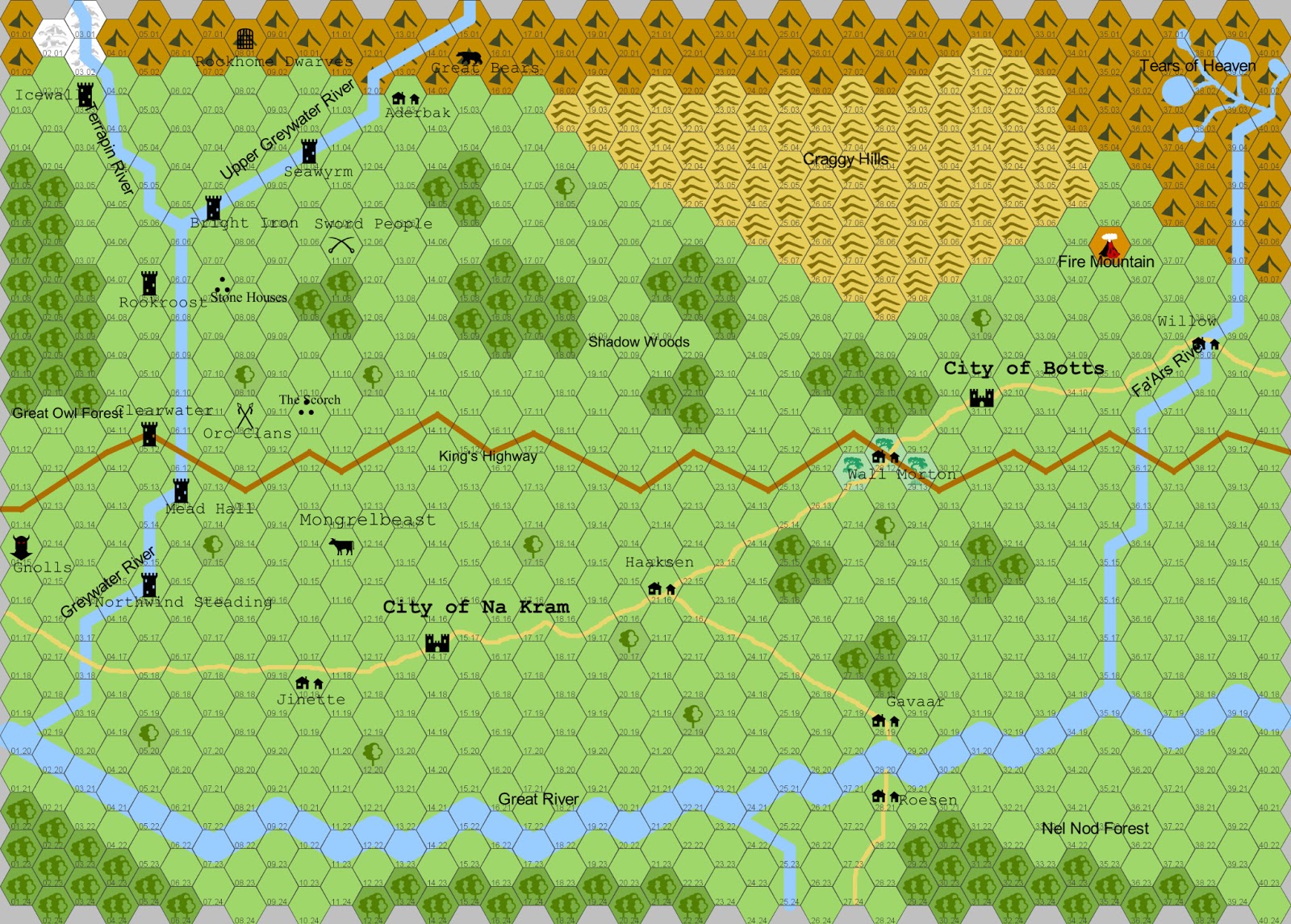

On the map can be seen the two main cities of the Sildur Reaches, Botts and Na Kram. Also a number of other features. In the western part of the Reaches, a lot of the details from the previous work on the Greywater Jarls is visible, including a number of the Steadings of the Jarls. Here is a list of the main features, by hex number, of this map.
0115 - Furlingga Gnolls (tribal area) Home of a number of roaming tribes of Gnolls.
0303 - Steading of Icewall - Icewall is the name of the northern most of the River Jarl steadings. It is the home of a very powerful clan of Storm King barbarians, the Isvater clan. The current head of the clan is Kolfinn Haukson. He is an old warrior, ruling his great clan, and his huscarls, with a firm but fair manner. He has a daughter, Vigdis Kilfinndottr - who is young, lovely, and given to romantic adventures. She has a group of friends, all young ladies, who attend her on all manner of adventures.
0508 - Steading of Rookroost - Rookroost is the name of the steading of the Daughters of the River Raven. It was once an impressive castle, built high on a rocky abutment that rises some 200 feet above the surface of the Erantor river, which runs out of the Great Owl Forest, to join the Greywater River. Today, the remains of the ancient castle are still standing, but the steading itself is built into the stone mound that it stands upon.
0512 - Steading of Clearwater - Near the point where the Greywater River passes under a great arch, to run beneath the King's Highway, there stands two fascinating structures. The first, of course is the tall, wide raised up artificial ridge that the King's Highway is built on. As detailed elsewhere, this artificiality was built by the Old Ones, probably by Ba'a Zarn the Builder. Up against this raised up ridgeline rises the small castle (steading) of Clearwater.
0516 - Northwind Steading - The furthest south of all the River Jarl Steadings, Northwind is further south than the King's Highway, almost half the distance between the King's Highway and the Great River. Some way south along the river, is the great ferry crossing of the Greywater, marking the point where the road between the baronies of Huygen and Na Kram cross the Greywater river.
0612 - Steading of Mead Hall - There is a skald's song that starts out "Mead Hall, Mead Hall - Home of Heroes Brave and Tall!" And it has, indeed, been a home for many heroes over the years. If there is a Steading of Storm King barbarians that fits the stereotypes that Westroners believe in - it is definitely Mead Hall.
0706 - Steading of Bright Iron -The current Jarl of Bright Iron is called Garret Fingolsson. His name is a curious one for a Storm King barbarian - since it includes a Westroner first name, but it was the name his father (Fingol the Just) gave him.
0708 - Stone Houses (ruins) - Immediately southeast of Bright Iron, just on the outskirts of the tended agricultural lands under the protection of Jarl Garret's fyrdmen, lay the lands of the Stone Houses. The Stone Houses are curious round structures, long since out of use by their original inhuman builders, made of stacked stones. The are similar to a Broch, or round house, that is built by some of the distant Storm King barbarians, however the roofs are all long since rotted off, and some of the stone walls are crumbling. What is curious about the structures, is that they are built for giant beings. Larger than an ogre, whomever it was that first peopled these stone houses must have been of a great stature, perhaps 15 feet tall? The typical stone house (as pictured below) has a first story that is partially underground, and then usually two more stories above that, and a peaked roof. Sometimes the roofs are present (when they were made out of slate or other stone) and sometimes they are long gone (when they were made out of material that would have rotted with age, such as wood or thatch). The typical structure is approximately 70 tall (at the peak of the roof), and about 80' across the base, at ground level. Of course, there is variation, so some exist that are taller or shorter, and either bigger or smaller around.
0801 - Rockhome Dwarven Kingdom - Rockhome is a city built into a mountain's roots, it is the capital of a kingdom of Dwarves that exists largely underground.
0811 - Orc Clans (tribal area) - Home of a number of tribes of roaming Orcs.
1004 - Steading of Seawyrm - Seawyrm is the northern most steading of the River Jarls along the Upper Greywater River. It is still a long way short of the edge of the Destriel Mountains, so the Upper Greywater is quite broad and wide by the time it reaches the shore where Seawyrm is constructed.
1011 - The Scorch - Southeast of Bright Iron, further south east even than the Stone Houses, there is a region along the border of the Orc Clan lands known as The Scorch. This is a rolling plain, among some gentle swells of the land, where all life has been burnt off. This was done during one of the wars between the Huscarls of Bright Iron and the Orc Clans. It was meant as a reminder of the edge of the Orc Clan Lands that Bright Iron would tolerate.
1018 - Town of Jinette - A walled independent town along the road between Na Kram and Huygens to the west. Population 4,250.
1107 - Sword People (tribal area) - These tribes of vicious and primitive savages are found mostly to the east, across the open plains between the Upper Greywater and the Shadow Woods. These plains are known as the Blood Veldt. The Sword People are a simple, bloodthirsty culture of savage barbarians that live in crude tribal groups (with simple shelters of sticks and skins that they erect), and make their basic economy by hunting the wooly rhinos of the Blood Veldt, and the herds of giant reindeer. Occasionally, and all too frequently, they will have some sort of religious frenzy where the young warriors of the tribes will go on a blood frenzy, traveling in random directions, and slaying any and every living thing they come across, leaving the dead just to rot. This is where the name Blood Veldt comes from...
1115 - Mongrelbeast Herds - East of Mead Hall, out across the Fields of Aton, between the Greywater River, and the Barony of Na Kram, roam the Mongrelbeast Herds. These are herds of giant elk, as found in other regions of the valley north of the Great River, but the herds here have been affected by some foul strain of Old One magic. A long time ago, a savage primitive people, similar to the Sword People north of the King's Highway in the same region, would wander and travel with the Giant Elk herds that have been trapped south of the King's Highway, since it was constructed. These people, called the Elkmen, would wander with the herds, culling some now and again for food and skins, but mostly living with them in peace, and for protection. The Elkmen had semi-domesticated some of the beasts to pull their great wheeled huts. The king of the Elkmen lived in a massive giant wheeled hut called the Roaming House.
1303 - Village of Aderbak - Several days northeast of Seawyrm, towards the southernmost fingers of stony ridges coming down out of the Destriel Mountains, there is a curious village. It is a small village made of stone buildings, and surrounded by a stout palisade, to aid in warding off the Sword People who venture that way. The village's name is Aderbak, and it is known to be the home of both the Princess of Roses, and the thorny portal.
1417 - City of Na Kram - Baronial seat of the Na Kram Barony. Home to the Dungeons of Borleos, a fearsome prison. Hol Kram, the Cathedral of Starry Wisdom, dedicated to Saint Gianna the Oracle, is located in Na Kram. Population, 18,000.
1502 - Kingdom of the Great Bears - Home of a race of intelligent, magic using cave bears.
2116 - Town of Haaksen - Independent walled town at the crossroads on the road between Na Kram and Wall Morton. Population 4,800. The Hospital of the Pierced Pelican is here - a religious hospital run by Sisters of the order of St. Brigid.
2812 - Town of Wall Morton - Independent town, with main buildings built on poles in the great Vinemorton Swamp, along the King's Highway. Population 5,200, although mostly outliers.
2819 - Town of Gavaar - Independent trading town on the northern bank of the Great River. Home of the Corsairs of Iron, funded by the Shiaress of Gavaar. Population 4,700.
2821 - Town of Roesen - Independent trading and fishing town on the southern bank of the Great River. Rival to the Shiaress of Gavaar, the Patriarch of Roesen funds the Ka'Bleez Marine - a small flotilla of patrol craft to protect trading ships from harassment by the Corsairs of Iron. Population 5,400.
3111 - City of Botts - Baronial seat of the Barony of Botts. Home to the bardic college of Brandismore, and also to the Grand Lyceum of Abjurative Sorcery. The Bardic College of Brandismore is located at Feyd Hall. The Lute Master of the Hall is Mistress Leanarra Gwayne. The school of Abjuration is located in the heart of the city of Botts. It is a walled campus of several buildings built upon a shining plaza made out of curious metals from a fallen asteroid. The head of the Lyceum is the Abjurer Glub Nar (male, human). Tolbe Cathedral (the Orphans' Cathedral) is located here, and is dedicated to St. Lilliane. Population, 17,500.
3507 - Fire Mountain - This curious volcano is riddled with layers and layers of caves and cavern complexes. It is home to a number of dragons, amongst other fouler creatures.
3809 - Town of Willow - Walled riverbank town that runs a ferry crossing the Fa'Ars River. Population 4,400.
Jun 12, 2012
Posting update and Schedule
The eight Steadings of the River Jarls are still being posted. The first five have been done, only three remain: Clearwater, Mead Hall, and Northwind. All three of these offer interesting setting descriptions, I think, and they each have an associated Adventure Location (which continues, and will finish, the Week of Adventure Locations).
In generating the Adventure Locations, references were made to locales, encounters, monsters and other elements. These are planned to be detailed in the next week or two, so more content is on the way.
Further out, the three cities of Khomaes (home of the Diamond Villas, and the Glamor Hall for Bewitchment and Entrancement, and near the Purple Marsh), Werms (location of the Demesne of Planar Knowledge and Magical Petitioning), and Huygen (site of the wretched Black Prison of Volvedma) will need to be detailed with their own postings, and a little bit more about the other features of the Darkearth Plains (aside from what has already been done). Then it is on to the next in the inter-river regions, between the Greywater and Fa'Ars River. That area, the Sildur Reaches, includes the two cities of Botts (including the Bardic College of Brandismore, and the Grand Lyceum of Abjurative Sorcery) and Na Kram. Also the Shadow Woods, Craggy Hills, Fire Mountain, and the curious Tears of Heaven (which is also Giant country).
Still working on the ValleyWiki idea...
In generating the Adventure Locations, references were made to locales, encounters, monsters and other elements. These are planned to be detailed in the next week or two, so more content is on the way.
Further out, the three cities of Khomaes (home of the Diamond Villas, and the Glamor Hall for Bewitchment and Entrancement, and near the Purple Marsh), Werms (location of the Demesne of Planar Knowledge and Magical Petitioning), and Huygen (site of the wretched Black Prison of Volvedma) will need to be detailed with their own postings, and a little bit more about the other features of the Darkearth Plains (aside from what has already been done). Then it is on to the next in the inter-river regions, between the Greywater and Fa'Ars River. That area, the Sildur Reaches, includes the two cities of Botts (including the Bardic College of Brandismore, and the Grand Lyceum of Abjurative Sorcery) and Na Kram. Also the Shadow Woods, Craggy Hills, Fire Mountain, and the curious Tears of Heaven (which is also Giant country).
Still working on the ValleyWiki idea...
Jan 11, 2011
The Order of Brother Rudiger
Brother Rudiger was an early priest who venerated the goddess of agriculture, Corrise. He was chiefly concerned, however, with the early communities of farmers that were beginning to spread out from the Baronial castles and their immediate protection, as Westroners spread throughout the northern part of the Valley in the 4th century after they migrated in from the West. Eventually, in year 487, Rudiger died, and a group of his followers constructed a small chapel in a nondescript sheep hamlet (with no name) west of the Barony of Botts (but east of the Shadow Woods).
 As farming communities grew, and villagers needed advice on building stronger stone buildings (to withstand years of the elements, and also attacks of the more dangerous denizens of the Valley) they would frequently consult members of the order, who would share the knowledge that Brother Rudiger developed in that regard (building and community design). Soon the demand caused the small order to begin spreading, and building its hallmark small stone chapels across the land, in many small hamlets and thorpes. A sub-order of itinerant monastics began as the Traveling Brothers, and then these spun a group of nuns as the Traveling Sisters. The small chapels are run by Community Vicars, and they will sometimes take up a vow of traveling over several years both to spread information about their own community, and to learn about other communities. There is a somewhat military arm of the Order known as the Hearthguard which consists of fighters who have taken vows of service (always only for a few years) as well as the priests of the order the Guardians of the Hearth (most player character members of the order would be of this group).
One of the main things outstanding about the Order of Brother Rudiger is the fact that it sponsors an order of knighthood, consisting of both commanders of the Hearthguard and also Paladins known as the Knights of the Hearth. These are covered elsewhere in the writeup on Paladins, but some words are worth covering here. The Knights of the Hearth do not wear a specific livery of the order (with the exception of sometimes the symbol of a knotted golden rope on their shield or breast), but instead adopt simple two colored dress, and adorn their weapons, mount, and armor with favors. These favors are collected at villages they visit in their pursuit of justice and chivalry.
Community Vicars, Traveling Brothers and Traveling Sisters (as well as Guardians of the Hearth) will appear in public only when dressed in their priestly raiment. That consists of simple brown robes (sometimes hooded, or not, according to the clime) tied with a golden knotted rope. Guardians of the Hearth may wear any armor, but it must be worn either under their robes, or with their robes still evident underneath the armor (so no full plate mail). If they employ shields while questing or defending a village, it should be a plain design, of a single color, with a golden knot as the only charge.
Spells available to priests of the order can come from the spheres of All, Creation and Healing. There is also minor access to the spheres of Combat and Protection.
Guardians of the Hearth are also taught techniques to incite fighters into a berserker rage (A willing warrior may be incited at most 1 time per day. It takes 1 round for the priest to incite the warrior. Then the warrior has +2 to hit and damage, and cannot leave the field of battle while foes still face him. Once he leaves, he chooses whether or not to emerge from the rage).
 All priests can share a Soothing Word three times per day. This can function either to remove the effects of a Fear spell or effect, or it can calm the reaction of animals or monsters, of hit dice up to twice the level of the Priest.
All priests also have the ability to turn undead creatures.
Priests of the order must have the NWP "Local History" of the community where they serve.
All sorts of armor and shields are available to Guardians of the Hearth. Weapons include dagers, dirks, flails, and the morningstar. The last two are preferred.
 As farming communities grew, and villagers needed advice on building stronger stone buildings (to withstand years of the elements, and also attacks of the more dangerous denizens of the Valley) they would frequently consult members of the order, who would share the knowledge that Brother Rudiger developed in that regard (building and community design). Soon the demand caused the small order to begin spreading, and building its hallmark small stone chapels across the land, in many small hamlets and thorpes. A sub-order of itinerant monastics began as the Traveling Brothers, and then these spun a group of nuns as the Traveling Sisters. The small chapels are run by Community Vicars, and they will sometimes take up a vow of traveling over several years both to spread information about their own community, and to learn about other communities. There is a somewhat military arm of the Order known as the Hearthguard which consists of fighters who have taken vows of service (always only for a few years) as well as the priests of the order the Guardians of the Hearth (most player character members of the order would be of this group).
One of the main things outstanding about the Order of Brother Rudiger is the fact that it sponsors an order of knighthood, consisting of both commanders of the Hearthguard and also Paladins known as the Knights of the Hearth. These are covered elsewhere in the writeup on Paladins, but some words are worth covering here. The Knights of the Hearth do not wear a specific livery of the order (with the exception of sometimes the symbol of a knotted golden rope on their shield or breast), but instead adopt simple two colored dress, and adorn their weapons, mount, and armor with favors. These favors are collected at villages they visit in their pursuit of justice and chivalry.
Community Vicars, Traveling Brothers and Traveling Sisters (as well as Guardians of the Hearth) will appear in public only when dressed in their priestly raiment. That consists of simple brown robes (sometimes hooded, or not, according to the clime) tied with a golden knotted rope. Guardians of the Hearth may wear any armor, but it must be worn either under their robes, or with their robes still evident underneath the armor (so no full plate mail). If they employ shields while questing or defending a village, it should be a plain design, of a single color, with a golden knot as the only charge.
Spells available to priests of the order can come from the spheres of All, Creation and Healing. There is also minor access to the spheres of Combat and Protection.
Guardians of the Hearth are also taught techniques to incite fighters into a berserker rage (A willing warrior may be incited at most 1 time per day. It takes 1 round for the priest to incite the warrior. Then the warrior has +2 to hit and damage, and cannot leave the field of battle while foes still face him. Once he leaves, he chooses whether or not to emerge from the rage).

All priests also have the ability to turn undead creatures.
Priests of the order must have the NWP "Local History" of the community where they serve.
All sorts of armor and shields are available to Guardians of the Hearth. Weapons include dagers, dirks, flails, and the morningstar. The last two are preferred.
Jan 3, 2011
Bardic Colleges
There are three widely recognized Bardic Colleges among the Westron Baronies, and also a distributed Bardic Circle amongst the tribes of the Storm King.
The three Bardic Colleges are located in the cities of Botts, Ockham and Gorrem. These are responsible for training in the craft and science of being a Bard. Within the Westron Baronies, and elsewhere, being a Bard can take on a number of different titles. Almost every castle of any size has a Troubadour, Jester, Minstrel or other educated musician. These sometimes appear to be Fools who only entertain their masters and the household, but they are finely trained in music, the ability to tell and remember a tale, as well as the ability to recall and pass on important information. Some Bards progress in the science of Magic as well. In addition to the castle Bards, there are many traveling Bards who bring news and information from place to place, as well as undertaking adventures and quests.
Each Baron with any sort of money also maintain a number of Heralds (more on that in a later post), many of which are also formally trained as Bards. While the City of Narn professes to have a College of Heralds (which one time was responsible for all nobility patents and lists throughout the Westron Baronies, now that has largely localized), all those who participate are educated at one or more of the Bardic Colleges listed here.
Almost all tribes or settlements amongst the Storm King tribes have a bard who is resident to that people. They don't have a formal school for training, but do all by word of mouth from one generation to the next (in the old fashion that the Westroners used to observe, before the establishment of the three Colleges).
The concept of a Bard is unknown amongst the Sun King tribes.
The three Bardic Colleges are located in the cities of Botts, Ockham and Gorrem. These are responsible for training in the craft and science of being a Bard. Within the Westron Baronies, and elsewhere, being a Bard can take on a number of different titles. Almost every castle of any size has a Troubadour, Jester, Minstrel or other educated musician. These sometimes appear to be Fools who only entertain their masters and the household, but they are finely trained in music, the ability to tell and remember a tale, as well as the ability to recall and pass on important information. Some Bards progress in the science of Magic as well. In addition to the castle Bards, there are many traveling Bards who bring news and information from place to place, as well as undertaking adventures and quests.
Each Baron with any sort of money also maintain a number of Heralds (more on that in a later post), many of which are also formally trained as Bards. While the City of Narn professes to have a College of Heralds (which one time was responsible for all nobility patents and lists throughout the Westron Baronies, now that has largely localized), all those who participate are educated at one or more of the Bardic Colleges listed here.
- In Gorrem, the Bardic College of Maelwyn (a master of the night harp from ancient times) is located. It is housed within the Tower of Druaqua, and the Master of the Tower is Chief Harper Terr Ondway.
- In Botts, the Bardic College of Brandismore is located at Feyd Hall. The Lute Master of the Hall is Mistress Leanarra Gwayne.
- In Ockham, the Bardic School of Arts is housed in the ancient castle Larkstone Heights (once a building of the Old Ones, constructed of a mysterious green stone). The headmaster of the school is Chanter Stuven Fivestar.
Almost all tribes or settlements amongst the Storm King tribes have a bard who is resident to that people. They don't have a formal school for training, but do all by word of mouth from one generation to the next (in the old fashion that the Westroners used to observe, before the establishment of the three Colleges).
The concept of a Bard is unknown amongst the Sun King tribes.
Dec 27, 2010
Wizardry and the Schools of Magic

The magic of Magic Users is known as arcane magic, or simply wizardry. It falls into a number of different schools, each having to do with a different aspect of magic. All practitioners, as usual, have access to the school of Lesser Divination (which provides the basic spells req'd for all spellcasters). Again, this is as per 2nd Ed rules.
The other 8 schools of magic, however, are all studied and researched at a number of different magical institutions, located in different cities. This is not to suggest that all of the magic users within a certain barony are of a certain school, only that the master of that school and the chief practitioners are located in a particular city. It is customary (but by no means universal) that rulers of Baronies will allow magic users to travel across borders, even during times of strife, if they are visiting a particular school and agree to a vow of peace while in the territory.
- Elder Institute for Necromantic Legerdemain - The school of Necromancy is located in the city of Devrie. It is a tall, spindly black tower, the dome of which is a huge white skull made of marble. The grounds around the tower - a large circle of land - are devoid of living things. The current grand master is Necromancer Malchaumis (male).
- Eldritch College of Channeling and Shaping - The school of Invocation and Evocation is located in the city of Lynch. It is a castle, with a number of massive round towers all about it, each of which is topped with a huge brazier that are constantly burning with multi-colored flames. Head mistress of the college is Shere Shard (human female)
- Ancient Presagery of Secrets and Mysteries -The school of Greater Diviniation is located in Pellorix. It is one of the oldest schools of magic in the Valley, being over a thousand years old. It is a simple manor house on the outside, surrounded by a walled garden. Inside the house are endless corridors and rooms - some of which are said to stretch on for miles and miles. The Chief Sage is Ciarra Pickthal (female)
- Tower of Thaumaturgical Flux - The school of Alteration is located in the city of Scallen. It is a massive tower, with the foundational layers made all of jade and emerald, but the top stories of which are constantly changing in composition and appearance. The Key of Alteration (current master of the school) is Mistress Trollencule (female).
- School for Mastery of the Illusionary Arts - The college of Illusion is located in the city of Ockham. It appears as a small castle, floating in the air above a perfectly calm pool. The castle is always different, and none but those within the School know it's true nature. The head of the School is Pandulf the Magnificent (male).
- Glamor Hall for Bewitchment and Entrancement - The school of Enchantment and Charm is located in the city of Khomaes. It is a great walled park, full of flowering plants and trees of all varieties, all year long. The portal to the halls and chambers of the school (a polished marble and gold arch, with royal purple drapes to be pulled aside) appear somewhere within the park to those who require entrance. The Queen of Enchantment (head of the school) is Mellisonde (female).
- Demesne of Planar Knowledge and Magical Petitioning - The school of Conjuration and Summoning is located at Werms. The school appears as a tall black castle, with lots of looming spires and towers, and is always surrounded by swirling clouds of black and grey fog and smoke. The current master, sitting the the Throne of Knowledge, is Yazeed the Traveller (male).
- Grand Lyceum of Abjurative Sorcery - The school of Abjuration is located in the city of Botts. It is a walled campus of several buildings built upon a shining plaza made out of curious metals from a fallen asteroid. The head of the Lyceum is the Abjurer Glub Nar (male).
 Any character that is a magic user or illusionist, especially a Human or Fey Changelings (half-elf) character, will have studied their basics at the school in question, regardless of their Barony of origin. A modicum of knowledge about how to travel to the school, and requirements for gaining entrance, are therefore part of the basics that the character knows from their initial training.
 Non human practitioners of magic (chiefly Elves and Gnomes) will often have their own masters. The major exception are the Gnomes of both the Oncor Hills and the Uidan Forest, many of which who practice magic take up their training at the School for Illusionary Arts at Ockham. Some even maintain that the School retains several Gnome Illusionists on its staff.
Dec 6, 2010
Paladins!

Gentle Knight was pricking on the plaine,
Y cladd in mightie armes and siluer shielde,
Wherein old dints of deepe wounds did remaine,
The cruell markes of many' a bloudy fielde;
Yet armes till that time did he neuer wield:
His angry steede did chide his foming bitt,
As much disdayning to the curbe to yield:
Full iolly knight he seemd, and faire did sitt,
As one for knightly giusts and fierce encounters fitt.
But on his brest a bloudie Crosse he bore,
The deare remembrance of his dying Lord,
For whose sweete sake that glorious badge he wore,
And dead as liuing euer him ador'd:
Vpon his shield the like was also scor'd,
For soueraine hope, which in his helpe he had:
Right faithfull true he was in deede and word,
But of his cheere did seeme too solemne sad;
Yet nothing did he dread, but euer was ydrad.- Edmund Spenser, 1596 A.D.
Vpon a great aduenture he was bond,
That greatest Gloriana to him gaue,
That greatest Glorious Queene of Faerie lond,
To winne him worship, and her grace to haue,
Which of all earthly things he most did craue;
And euer as he rode, his hart did earne
To proue his puissance in battell braue
Vpon his foe, and his new force to learne;
Vpon his foe, a Dragon horrible and stearne.
The Paladin is a crucial element in the battle between good and evil in the Valley of the Old Ones. As servants of a higher authority, they are subject to review of their adherence to the laws of chivalry. A brief word or two seems in order, so that a player who chooses this class would know what sort of Holy order they are buying into, in the game world.
There are, in the main, three orders of Paladins among the Westroners in the Valley of the Old Ones. All three are lawful good, and have Paladins who are played exactly as the rules prescribe (no variation in class, alignment, abilities, etc). There are anti-paladins (and worse) in the game setting, but these will be discussed another time.
 First, is the Order of Knights of the White Lady. The White Lady is one of many names given to the eldest daughter of the goddess Magenta. She is the incarnate as the largest of the three moons that travel across the sky above the Valley of the Old Ones. Her role in the world is to battle evil and monsters wherever they may be found. In this she stands in opposition to many of those who are not good, but who still look to Magenta (the goddess of Magic) for guidance and power. One of the curious worldly aspects of the White Lady is that fact that in her appearance as the large white moon, known by her proper name Poritia Nove, she casts no reflection on the Two Moon river. For that reason, many evil creatures and men have decided that they are more safe in that region than elsewhere in the valley, and it is a magnet for vile creatures and beings of all stripes.
There are, of course, priests and monks and nuns of the White Lady, but those will be detailed elsewhere. The Paladins of this order are a typical chivalric order, as was common on Earth around the 13th or 14th century. A long period of training and serving as a squire would precede the actually conference of Knighthood on the player. The act of passing from level 0 to level 1 coincides with being Knighted into the order (something that occurs before the start of the campaign for most characters). A patent of nobility is expected from the family (even if impoverished) for those who would join this order.
Paladins of the White Lady will dress all in white robes - silk if possible. Their symbol is a black heater shield, with a white disc in the upper right corner. This symbol - the shield with the white disc - appears on the breast of their tunics, on military pennons and banners, and also as the device on their shield. Individual knights in the order do not wear personalized heraldry.
In addition to the normal chivalric duties of protecting the honor of women, defending innocents, and meting out justice the knights of the Order are primarily interested in vanquishing evil wherever it may be found. This is a very aggressive order.

After a while, it turned out that bands of the Priests from the order were doing more fighting than anything else, and that gave order to the Paladin's order.
These knights are sometimes known as the Peasant Paladins for they will accept anyone, regardless of a noble patent or not. They have just as stringent requirements as the other orders, but welcome those of ability, rather than just those of a high birth.
The knights of the order are not interested in military adventures against strongholds of evil, nor do they seek questing. These are simple, quite utilitarian knights who seek to protect the people that they serve from evil and injustice. Never ones to back down from a fight, they also do not seek it out. One of the things that many knights of this order secretly desire is to be able to fight, and perhaps sacrifice themselves, in a desperate battle defending innocents against overwhelming odds of evildoers.
The livery of the Knights of the Hearth is quite interesting. They do not have any heraldic symbol, choosing instead individually a set of simple clean livery, consisting often of just one or two colors. In their pursuit of justice and the defense of the helpless, it is quite common for Knights of the Hearth to collect favors and to adorn their armor and weapons with the same.
Finally, there are is the Brotherhood of the Sword. These knights came out of the Order of St. Lilliane, that formed when the Cathedral of St. Lilliane was defiled and destroyed by trolls. The surviving priests took up arms, implored the local secular Knight, Sir Vallimor of Botts to train them in the use of arms, and thus the fighting order was born. These knights took an oath on an inverted sword, and that remains their symbol to this day.
Of all the three orders, the Brotherhood of the Sword is the most prone to solo wandering and adventuring. Given strongly to the idea of a quest or mission errant, the brothers will often go on long quests lasting years - following the code of chivalry the entire time they are out questing, always upholding the Paladin code, as well as the reputation and honor of their order.
The livery of the order is simple. It is a white tunic, and a white shield, with a red upended sword portrayed on the center of each. This, in simplest form, appears as a red cross.

Subscribe to:
Posts (Atom)