Showing posts with label St. Lilliane. Show all posts

Feb 17, 2013

Sildur Reaches - Sandbox Map

[I have let this blog go mostly dormant, since September of 2012.  That was when I started teaching my first semester as a Professor at Columbus State University, and I have been busy.  However, I was working away on a number of different parts of the Valley of the Old Ones, although my current gaming interests take me in the directions of doing the next inter-river region of the world, the Sildur Reaches.  I am developing this in the manner of an Old School sandbox region, for players to explore and adventure in, without an over-riding plot or adventure theme.  The first step, of course, is a hexmap of the region . . .] 

So, here is the map of the Sildur Reaches, developed using Hexographer (a fantastic program, I highly recommend it).  Each hex on the map represents 25 miles across.  This is a region approximately 1000 miles wide, and about 600 miles from north to south.  My plans, for sandbox gaming, are to pick one or two areas, and then do a higher detail (smaller scale - probably 5 mile hexes, similar to the old Judges Guild village book hexmaps) treatment, showing lairs, adventure sites, dungeons, ruins, etc.
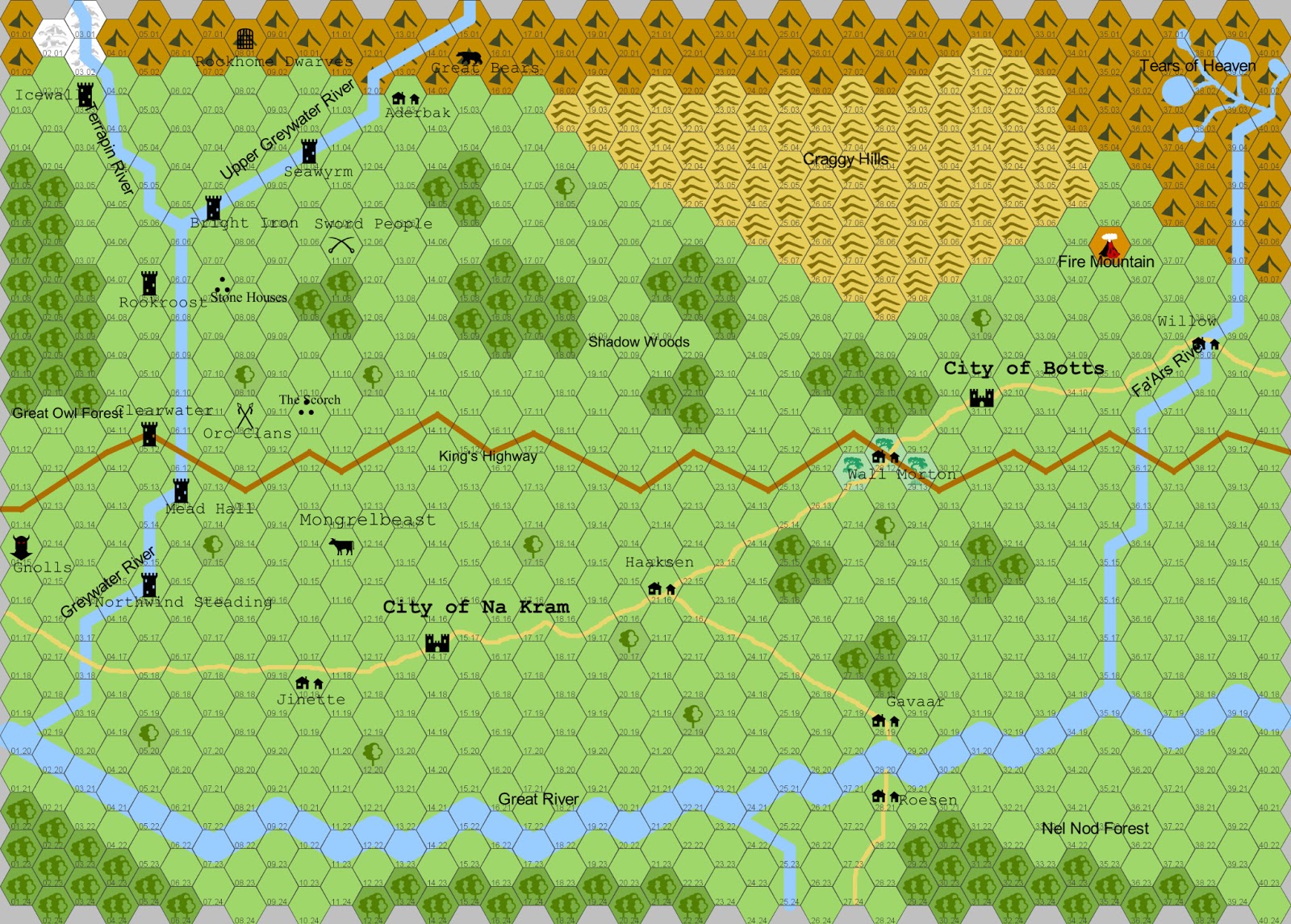


On the map can be seen the two main cities of the Sildur Reaches, Botts and Na Kram.  Also a number of other features.  In the western part of the Reaches, a lot of the details from the previous work on the Greywater Jarls is visible, including a number of the Steadings of the Jarls.  Here is a list of the main features, by hex number, of this map.

0115 - Furlingga Gnolls (tribal area) Home of a number of roaming tribes of Gnolls.

0303 - Steading of Icewall - Icewall is the name of the northern most of the River Jarl steadings.  It is the home of a very powerful clan of Storm King barbarians, the Isvater clan.  The current head of the clan is Kolfinn Haukson.  He is an old warrior, ruling his great clan, and his huscarls, with a firm but fair manner.  He has a daughter, Vigdis Kilfinndottr - who is young, lovely, and given to romantic adventures.  She has a group of friends, all young ladies, who attend her on all manner of adventures.

0508 - Steading of Rookroost - Rookroost is the name of the steading of the Daughters of the River Raven.  It was once an impressive castle, built high on a rocky abutment that rises some 200 feet above the surface of the Erantor river, which runs out of the Great Owl Forest, to join the Greywater River.  Today, the remains of the ancient castle are still standing, but the steading itself is built into the stone mound that it stands upon.

0512 - Steading of Clearwater - Near the point where the Greywater River passes under a great arch, to run beneath the King's Highway, there stands two fascinating structures. The first, of course is the tall, wide raised up artificial ridge that the King's Highway is built on.  As detailed elsewhere, this artificiality was built by the Old Ones, probably by Ba'a Zarn the Builder.  Up against this raised up ridgeline rises the small castle (steading) of Clearwater.

0516 - Northwind Steading - The furthest south of all the River Jarl Steadings, Northwind is further south than the King's Highway, almost half the distance between the King's Highway and the Great River.  Some way south along the river, is the great ferry crossing of the Greywater, marking the point where the road between the baronies of Huygen and Na Kram cross the Greywater river.

0612 - Steading of Mead Hall - There is a skald's song that starts out "Mead Hall, Mead Hall - Home of Heroes Brave and Tall!"  And it has, indeed, been a home for many heroes over the years.  If there is a Steading of Storm King barbarians that fits the stereotypes that Westroners believe in - it is definitely Mead Hall.

0706 - Steading of Bright Iron -The current Jarl of Bright Iron is called Garret Fingolsson.  His name is a curious one for a Storm King barbarian - since it includes a Westroner first name, but it was the name his father (Fingol the Just) gave him.

0708 - Stone Houses (ruins) - Immediately southeast of Bright Iron, just on the outskirts of the tended agricultural lands under the protection of Jarl Garret's fyrdmen, lay the lands of the Stone Houses.  The Stone Houses are curious round structures, long since out of use by their original inhuman builders, made of stacked stones.  The are similar to a Broch, or round house, that is built by some of the distant Storm King barbarians, however the roofs are all long since rotted off, and some of the stone walls are crumbling. What is curious about the structures, is that they are built for giant beings.  Larger than an ogre, whomever it was that first peopled these stone houses must have been of a great stature, perhaps 15 feet tall?  The typical stone house (as pictured below) has a first story that is partially underground, and then usually two more stories above that, and a peaked roof.  Sometimes the roofs are present (when they were made out of slate or other stone) and sometimes they are long gone (when they were made out of material that would have rotted with age, such as wood or thatch).  The typical structure is approximately 70 tall (at the peak of the roof), and about 80' across the base, at ground level.  Of course, there is variation, so some exist that are taller or shorter, and either bigger or smaller around.

0801 - Rockhome Dwarven Kingdom - Rockhome is a city built into a mountain's roots, it is the capital of a kingdom of Dwarves that exists largely underground.

0811 - Orc Clans (tribal area) - Home of a number of tribes of roaming Orcs.

1004 - Steading of Seawyrm - Seawyrm is the northern most steading of the River Jarls along the Upper Greywater River.  It is still a long way short of the edge of the Destriel Mountains, so the Upper Greywater is quite broad and wide by the time it reaches the shore where Seawyrm is constructed.

1011 - The Scorch - Southeast of Bright Iron, further south east even than the Stone Houses, there is a region along the border of the Orc Clan lands known as The Scorch.  This is a rolling plain, among some gentle swells of the land, where all life has been burnt off.  This was done during one of the wars between the Huscarls of Bright Iron and the Orc Clans.  It was meant as a reminder of the edge of the Orc Clan Lands that Bright Iron would tolerate. 

1018 - Town of Jinette - A walled independent town along the road between Na Kram and Huygens to the west. Population 4,250.

1107 - Sword People (tribal area) - These tribes of vicious and primitive savages are found mostly to the east, across the open plains between the Upper Greywater and the Shadow Woods.  These plains are known as the Blood Veldt.  The Sword People are a simple, bloodthirsty culture of savage barbarians that live in crude tribal groups (with simple shelters of sticks and skins that they erect), and make their basic economy by hunting the wooly rhinos of the Blood Veldt, and the herds of giant reindeer.  Occasionally, and all too frequently, they will have some sort of religious frenzy where the young warriors of the tribes will go on a blood frenzy, traveling in random directions, and slaying any and every living thing they come across, leaving the dead just to rot.  This is where the name Blood Veldt comes from...

1115 - Mongrelbeast Herds - East of Mead Hall, out across the Fields of Aton, between the Greywater River, and the Barony of Na Kram, roam the Mongrelbeast Herds.  These are herds of giant elk, as found in other regions of the valley north of the Great River, but the herds here have been affected by some foul strain of Old One magic.  A long time ago, a savage primitive people, similar to the Sword People north of the King's Highway in the same region, would wander and travel with the Giant Elk herds that have been trapped south of the King's Highway, since it was constructed.  These people, called the Elkmen, would wander with the herds, culling some now and again for food and skins, but mostly living with them in peace, and for protection.  The Elkmen had semi-domesticated some of the beasts to pull their great wheeled huts.  The king of the Elkmen lived in a massive giant wheeled hut called the Roaming House.

1303 - Village of Aderbak - Several days northeast of Seawyrm, towards the southernmost fingers of stony ridges coming down out of the Destriel Mountains, there is a curious village.  It is a small village made of stone buildings, and surrounded by a stout palisade, to aid in warding off the Sword People who venture that way.  The village's name is Aderbak, and it is known to be the home of both the Princess of Roses, and the thorny portal.

1417 - City of Na Kram - Baronial seat of the Na Kram Barony.  Home to the Dungeons of Borleos, a fearsome prison. Hol Kram, the Cathedral of Starry Wisdom, dedicated to Saint Gianna the Oracle, is located in Na Kram.  Population, 18,000.

1502 - Kingdom of the Great Bears - Home of a race of intelligent, magic using cave bears.

2116 - Town of Haaksen - Independent walled town at the crossroads on the road between Na Kram and Wall Morton. Population 4,800.  The Hospital of the Pierced Pelican is here - a religious hospital run by Sisters of the order of St. Brigid.


2812 - Town of Wall Morton - Independent town, with main buildings built on poles in the great Vinemorton Swamp, along the King's Highway. Population 5,200, although mostly outliers.

2819 - Town of Gavaar - Independent trading town on the northern bank of the Great River.  Home of the Corsairs of Iron, funded by the Shiaress of Gavaar. Population 4,700.

2821 - Town of Roesen - Independent trading and fishing town on the southern bank of the Great River.  Rival to the Shiaress of Gavaar, the Patriarch of Roesen funds the Ka'Bleez Marine - a small flotilla of patrol craft to protect trading ships from harassment by the Corsairs of Iron. Population 5,400.

3111 - City of Botts - Baronial seat of the Barony of Botts.  Home to the bardic college of Brandismore, and also to the Grand Lyceum of Abjurative Sorcery.  The Bardic College of  Brandismore is located at Feyd Hall.  The Lute Master of the Hall is Mistress Leanarra Gwayne.  The school of Abjuration is located in the heart of the city of Botts.  It is a walled campus of several buildings built upon a shining plaza made out of curious metals from a fallen asteroid. The head of the Lyceum is the Abjurer Glub Nar (male, human).  Tolbe Cathedral (the Orphans' Cathedral) is located here, and is dedicated to St. Lilliane.  Population, 17,500.

3507 - Fire Mountain - This curious volcano is riddled with layers and layers of caves and cavern complexes.  It is home to a number of dragons, amongst other fouler creatures.

3809 - Town of Willow - Walled riverbank town that runs a ferry crossing the Fa'Ars River. Population 4,400.


Jul 7, 2012

Cloud Pillars of Werms

If you have visited the city, then you know that the pillars that rise up out of the Cambio Delve - those that the city of Werms is built upon - are constantly enshrouded in banks and banks of fluffy white clouds.

This, alchemists will tell us, has to do with the difference between the temperature and conditions of the airs that blow down out of the Destriel Mountains across the opening of the Delve, and the conditions of the rising airs that come up out of the abyssal depths of the Delve. An explanation that only matters to an alchemist, I know, but that is what it is.

Each pillar has its own name, of long tradition in the history of the ancient city, and some are known for certain structures that mark them as landscapes. Common features among many of the pillars are the irregular shape of their topmost tips - although the Westron builders have tamed that through building up stone structures in different layers, and at different heights, still the streets among those structures are very "hilly" in nature. On almost all of the pillars (the only exceptions being The Spire and Ancro Pillar) there is some natural water source. Some of these were natural, and others have been created through the centuries, by magical means. Much of the foodstuffs of the city, however, are grown in the pastoral lands in the rolling hills surrounding the Delve. Below are some brief descriptions of the different pillars.


A. Eindar Pillar - Eindar Pillar suffers somewhat in beauty and spendor because it is right next to the Mound of Etro. It is home to several notable sectors of town, including some noble villas, a number of highly skilled smiths (silver smiths, gold smiths, etc), and houses the main Aery of the City Guard Gryphons. Eindar Pillar has stone bridges connecting it to Learan Rock (B) and also the Mound of Etro (G). The abandoned lower city structure on Eindar Pillar is some of the oldest in the city, barring the Globe Keep on the Mound of Etro, and there are layers and layers of city buried underneath some. Much of the original layer consisted of villas owned by the leading equestrian families that served Baron Ap Etro. Among them was the famous Harmalan family. The ruined Harmalan villa is the location of the web-lair of Ostigaar.

B. Learan Rock - Learan Rock is home to many wealthy residences. Few businesses are here, other than personal service businesses (tailors, haberdashers, furriers, bath houses, and similar, but fewer than supposed because many households have their own skilled servants).

C. Pili Ronser - Pili Ronser is one of the few stone abutments that were originally settled by the Lass Indol people that traveled with Baron Ap Etro when they settled the city. They strong influence of these people is the reason for the Cathedral of Frigia Nor being here in Werms, and it is located on Pili Ronser. Pili, by the way, is a Lass Indol word meaning speartip. Pili Ronser is connected by stone bridges to Morning Glow (F) and Learan Rock (B). The Cathedral, is called Skyhome, and features a number of high soaring towers, with bronze exteriors, that shine brightly in the sun, when it fingers between the clouds.

D. Pili Timro - The two civic institutions that the Baron is most proud of are located here, along with much housing for artisans and craftsmen. The first institution is a school for the children of the "middle classes". In a Westron style city, that means the children of skilled labor, guild members, and merchants. It is simply called the Academy. Outside the Barony, it is referred to as the Werms Academy. It is one of a few such in the whole Valley, but a few hundred years back, Baron Hio Ap Yelton ("The Scribbling Baron") thought the Barony would benefit from widespread literacy.
The second such institution is the Baronial Preserve. This is a sort of public park, where all sorts of exotic animals and captured monsters and odd foreign people are kept on display.

E. Avin Rock - This is the location of many of the professional guilds (other than the Alchemists Guild, which in Werms is rather small, but is also isolated on Aster Height). One of the more notable guilds is the Fellowship of the Shield (a fighters and mercenaries guild). The horses, servants,and squires of the Baron's knights are also found here, and there is a rivalry between the royal men at arms and the sell-swords and bravos of the Fellowship. The Baronial knights maintain a very large stable compound across the stone bridges on the surrounding countryside. Only the horses of senior knights are permitted on the Rock. Needless to say, other than frequent (but rarely deadly) duels between the royal knights and the sell-swords, there are also ongoing rivalries with the city guard, and especially the gryphon riders. The knights consider them common soldiery.

F. Morning Glow - Location of many of the wealthiest villas and estates. The private residence of many professionals is located on Morning Glow. The name comes from the veins of exposed metal in the stone of the pillar (dwarves believe it is a form of "goblyn gold" that shines but is worthless) that shine so brightly in the sunrise.

G. Mound of Etro - This is the location of the Globe Keep - the capital building of the city, and also the seat of power for the Barony of Werms. Bridges exist between the Mound of Etro and Eindar Pillar (A), Pili Ontoom (H), the Pillar of E'Dlum (L) and The Spire (M).

H. Pili Ontoom - In addition to many artisans and craftsmen making their home on Pili Ontoom, it is also the location of a small Monastery. It is a mixed gender monastery dedicated to St. Gianna.

K. Toan Rock - The Hospital of Allumes is located on Toan Rock, as are a number of herb and spice merchants. Many of the herb merchants own walled villas here, and the smells of their herb gardens fill the air of the whole Rock. Allumes Hospital is run by an order of sisters of St. Lilliane, and Paladins of the Brotherhood of the Sword (Sword Brothers, as no other titles or rank is recognized in that order). The Sword Brothers are not permanently attached to the hospital, but in their questing across the North of the Darkearth Plains, they check in at the hospital at least annually when possible.

L. Pillar of E'Dlum - This is the location of the Cloudhome Cathedral (the main cathedral of the Order of St. Leiathar, of the Nadene branch of the Westron church), as well as a number of private villas, and some very high end specialist businesses (poetry tutors, specialist jewelers, etc). There are stone bridges connecting the Pillar of E'Dlum with the Mound of Etro (G), Toan Rock (K), and Tuvril Quarry (P). Some of the wealthier and more selectives of E'Dlum work very hard to keep the market on the Tuvril Quarry bridge shut down as much as possible, and they discourage visitors from that pillar, since they have a dim memory of when it was a working rock quarry.

M. The Spire - The Spire is named not so much for the pillar itself, but for the curious structure that arises from it's top surface. It is a very tall (180') very large (60' diameter) pillar of marble. Approximately every 30' or so, moving up the pillar, are large porticos wrapping around (always exactly) half of the pillar, and extending out 60' into space with no visible means of support, but apparently of the same marble as the pillar. There are no stairs or carved ladders between these layers, but there are stone railings around the outer edge of each porch. The top is topped with a massive platform, a full 180' across and surrounded by the same 4' high railing as the other layers. It existed when the city was formed, and space on the 'spire' quickly became a very prestigious premium. Today it serves as home to visiting dignitaries from other cities, churches, and magical schools.

N. Stomal Rock - Any visitor to Stomal is completely aware of two things immediately.
First are the artificial platforms surrounding the outskirts of the pillar. These house row after row of giant bee hives, tended by a number of stone golems. The walls of the pillar, reaching down as far as light can travel, are covered with a family of differing flowering vines called "The flowers of the Moons". The do blossom in three distinct types - white, red, and golden - correlating to the three moon Goddesses, daughters of Magenta. All three produce blossoms of a gargantuan size, and enough to satisfy the giant bees. The golems are controlled by a number of magic using merchants who sell the products of the bees (honey and wax).
The second noticeable item immediately apparent on visiting Stomal rock are the number of layers of city that have been covered over. And from exposed vents and shafts from the older parts, trails of smoke indicate that they are still occupied by hundreds of peasant families.

P. Tuvril Quarry - The quarry is so named because it is made of several types of very hard stone, including granite and marble, that were exposed on the top surface of the pillar when the city was settled, and for hundreds of years lay open as a baronial quarry. Eventually, the space was needed, and the mining and quarrying operations began to dig deep down shafts into the pillar, as layers of stone city structure was built overhead. In digging down, the miners uncovered veins of rich metals and also several cave systems, some inhabited.

Q. Den Kar Pillar - The second highest pillar, after the Mound of Etro, Den Kar is a home for wealthy residents on the surface, and progressively poorer laborers and peasants in the lower levels. A number of those residences belong to wizards and sorcerers, and feature tall towers rising up above the walled residences themselves.

R. Ditro Pillar - Other than the many market stalls and open bazaars that line the stone bridges between pillars, the open market at Ditro is the largest area given over to trade and mercantilism in the city. Located because of the Western Gate, all other stone bridges leading from Ditro (to Den Kar) are heavily guarded and feature stout gate houses. Outsiders from the surrounding countryside are frequently seen in Ditro. The lower levels of this part of the city are full of all manner of criminals, even though they make practice their crimes throughout the city. In fact, the thieves and assassins guild pretty much make sure no crimes are committed in Ditro against citizens of Werms, as sort of an unspoken truce with the city guard.

S. Aster Height - This isolated pillar is the home of the small, but active guild of Alchemists. The Alchemists and their guests travel back and forth to the heights via means of potion and other magical devices. There is an uneasy peace between the Alchemists and the city guard, as the guild maintains a colony of pseudo dragons here on the pillar, and occasionally the gryphons belonging to the city guard will eat an unsuspecting young pseudo dragon just learning to fly. Repercussions are frequently out of proportion, but the guild members are fond of their little draconian pets.

T. Usal Rock - While this pillar is mostly uninhabited, and undeveloped, it is used as a training field for the city guard, especially the gryphon riders. There are some crude barracks and stables constructed here, but almost all consumable needs (water, food, etc) need to be brought by the troops when they come for periods of training.

U. Ancro Pillar - This pillar sat empty for the first 200 years of the city's history, but eventually Ancro the Summoner came and established the magical school of conjuration and summoning, called the "Demesne of Planar Knowledge and Magical Petitioning". This pillar, and the school, in contrast to the remainder of the city, are always surrounding by swirling black clouds. The remainder of the pillar, aside from the school of magic, is given over to feudal peasants that serve the school, tending little patches of gardens and penned animals. The small number of craftsmen that are required to support the activities of the school are also here.

Dec 28, 2010

Specialty Priests of the Westron Church (part 3)

These are the priests affiliated with the Goddess of Agriculture, Corrise.

Corrise - Goddess of Agriculture
  • Priest's Alignment: Neutral Good
  • Minimum Abilities: Wisdom 11, Constitution 12. Wisdom or Constitution 16 means +5% experience; Wisdom and Constitution 16 means +10% experience.
  • NWP and WPN Prof: Agriculture (required). No Weapons required; NWPs allowed: Priest, General.
  • Weapons and Armor: Bill, flails (both), hand-throwing axe, scythe, sickle. Armor Permitted: All non-magical non-metal armor, all non-magical (non-metal) shields.
  • Restrictions: None.
  • Major Spheres: All, Creation, Divination, Plant, and Summoning (can only use wall of thorns , weather summoning , and creeping doom from this sphere).
  • Minor Spheres: Animal, Healing, Protection, Sun, and Weather.
  • Powers: Identification A priest of Corrise can examine any normal (non-magical) plant and determine if it is healthy, if not what is wrong with it, where it naturally grows, etc; Create Food and Water (Priest can cast this once per day, for free); Immune to any food poisoning from vegetable source; Heroes' Feast - at 8th Level can cast this once per day.
  • Symbol: Sheaf of Wheat
Green Man - Demigod of Vegetation and Plants, husband of Corrise
  • Priest's Alignment: True Neutral, Neutral Good, or Lawful Neutral
  • Minimum Abilities: Wisdom 9. Wisdom 16 means +10% experience.
  • NWP and WPN Prof: Herbalism (required). Sickle Weapon required; NWPs allowed: Priest, General, Warrior.
  • Weapons and Armor: Club, quarterstaff, scythe, sickle. Armor Permitted: No armor; all wooden shields (no metal or leather).
  • Restrictions: May not wear Leather or Furs in their clothing.
  • Major Spheres: All, Divination, Healing, Plant, Protection, Summoning, Weather.
  • Minor Spheres: Combat, Creation, Guardian, Necromantic, Sun.
  • Powers: Identify any plant (magical or non-magical) perfectly; Pass through Overgrowth (as per Druid, but at 1st level).
  • Symbol: Oak Leaf and Acorn.
Saint Ermo - Patron Saint of the Earth and Building
  • Priest's Alignment: True Neutral.
  • Minimum Abilities: Wisdom 12. Wisdom 16 means +10% experience.
  • NWP and WPN Prof: Required one of (Mining, Stonemasonry). No Weapons required; NWPs allowed: Priest, General.
  • Weapons and Armor: Club, dagger/dirk, knife, mace, maul, morning star, picks (all), scythe, sickle, sling, staff sling, stiletto, warhammer. Armor Permitted: All non-magical non-metal armor, all non-magical non-metal shields.
  • Restrictions: None.
  • Major Spheres: All, Creation, Elemental (the priest may only use spells dealing with dust, stone, rock, mud, and earth, plus transmute metal to wood ), Plant, Summoning.
  • Minor Spheres: Animal, Divination, Healing, Protection.
  • Powers: Immune to all Snake venoms (+3 to saving throw); Detect grade or slope as per Dwarf (if character is already a Dwarf, then chances improve by 1 on the dice); Determine approximate depth underground as per Dwarf (if character is already a Dwarf, then chances improve by 1 on the dice).
  • Symbol: Stone.
  • Homehall Cathedral, in Gorrem
  • Monastery - Harmonious Reflectory of Order in Octorix, Barony of Henn
Brother Rudiger - Patron Saint of Home and Community- detailed writeup here.
  • Priest's Alignment: Any non-evil alignment.
  • Minimum Abilities: Wisdom 10, Charisma 12. Wisdom or Charisma 16 means +5% experience; Wisdom and Charisma 16 means +10% experience.
  • NWP and WPN Prof: Local History (required). No Weapons required; NWPs allowed: Priest, General.
  • Weapons and Armor: Dagger/Dirk, Knife, Flails (both), Morningstar. All armors and shields allowed.
  • Restrictions: Priests of the order of Brother Rudiger must always wear vestments indicating their priestly status.
  • Major Spheres: All, Creation, Healing.
  • Minor Spheres: Combat, Protection.
  • Powers: Incite Berserker Rage (A willing warrior may be incited at most 1 time per day. It takes 1 round for the priest to incite the warrior. Then the warrior has +2 to hit and damage, and cannot leave the field of battle while foes still face him. Once he leaves, he chooses whether or not to emerge from the rage); Soothing Word 3x a day (can remove a Fear spell or calm down animals or monsters up to 2x the priests level); Turn Undead (as per Cleric in PHB);
  • Symbol: Knotted golden rope.
Saint Lilliane - Patron Saint of Orphans and the Dispossessed
  • Priest's Alignment: Neutral Good, Lawful Good, Lawful Neutral.
  • Minimum Abilities: Wisdom 12, Strength 12. Wisdom or Strength 16 means +5% experience; Wisdom and Strength 16 means +10% experience.
  • NWP and WPN Prof: Healing (required). No Weapons required; NWPs allowed: Priest, General.
  • Weapons and Armor: Dagger/dirk, knife, stiletto, swords (all). Armor Permitted: All armor, all shields.
  • Restrictions: May never turn away an individual looking for hospitality.
  • Major Spheres: All, Charm, Healing.
  • Minor Spheres: Combat, Creation, Divination, Protection.
  • Powers: Soothing Word 3x a day (can remove a Fear spell or calm down animals or monsters up to 2x the priests level); Laying on Hands (as per Paladin in PHB)
  • Symbol: Open Hands.
  • Tolbe Cathedral - in Botts (also known as the Orphans' Cathedral)
Saint Varina - Patron Saint of Vineyards and Wine
  • Priest's Alignment: Neutral Good, Chaotic Good.
  • Minimum Abilities: Wisdom 9. Wisdom 16 means +10% experience.
  • NWP and WPN Prof: Brewing (required). No Weapons required; NWPs allowed: Priest, General.
  • Weapons and Armor: Club, scythe, sickle. Armor Permitted: All armor and shields.
  • Restrictions: None.
  • Major Spheres: All, Charm, Elemental, Plant, Protection.
  • Minor Spheres: Divination, Healing, Sun, Weather.
  • Powers: Immune to the effects of Alcohol; Soothing Word 3x a day (can remove a Fear spell or calm down animals or monsters up to 2x the priests level); Turn Undead (as per Cleric in PHB); Constitution raised to 18 at level 8.
  • Symbol: Bunch of Grapes.
Saint Norena - Patron Saint of Fire and Comfort
  • Priest's Alignment: Neutral Good, Chaotic Good, True Neutral.
  • Minimum Abilities: Wisdom 10, Intelligence 10. Wisdom or Intelligence 16 means +5% experience; Wisdom and Intelligence 16 means +10% experience.
  • NWP and WPN Prof: Firebuilding (required). No Weapons required; NWPs allowed: Priest, General, Wizard.
  • Weapons and Armor: Bill, dagger/dirk, knife, stiletto, swords (all). Armor Permitted: All metal armor, all metal shields.
  • Restrictions: None.
  • Major Spheres: All, Elemental (the priest may only use the spells whose names include the words Fire, Flame, Heat, Pyrotechnics, and the spell chariot of Sustarre ), Sun.
  • Minor Spheres: Charm, Divination, Healing, Necromantic, Protection, Weather.
  • Powers: Soothing Word 3x a day (can remove a Fear spell or calm down animals or monsters up to 2x the priests level); Immune to fire and heat attacks (+2 to saving throw); Create Food and Water once per day.
  • Symbol: Cooking Fire.
  • Appuco Fast cathedral - Khomaes
Olimo Vis - Demigoddess of Autumn and the Harvest
  • Priest's Alignment: Lawful Good, Chaotic Good, Neutral Good.
  • Minimum Abilities: Wisdom 10, Intelligence 10. Wisdom or Intelligence 16 means +5% experience; Wisdom and Intelligence 16 means +10% experience.
  • NWP and WPN Prof: No Weapons required; NWPs allowed: Priest, General.
  • Weapons and Armor: Club, quarterstaff, scythe, sickle. Armor Permitted: No armor; all wooden shields (no metal or leather).
  • Restrictions: None.
  • Major Spheres: All, Divination, Healing, Necromantic, Plant, Summoning, Weather.
  • Minor Spheres: Animal, Charm, Creation, Elemental, Protection, Sun.
  • Powers: Immunity (automatic successful save) vs. all priest spells of the Elemental Sphere, and wizard spells with coldness and/or heat in their name; Soothing Word 3x a day (can remove a Fear spell or calm down animals or monsters up to 2x the priests level).
  • Symbol: Leaf.
Elongar Suu - Demigoddess of Summer and Growth
  • Priest's Alignment: Neutral Good, Chaotic Good.
  • Minimum Abilities: Wisdom 10, Dexterity 10. Wisdom or Dexterity 16 means +5% experience; Wisdom and Dexterity 16 means +10% experience.
  • NWP and WPN Prof: No Weapons required; NWPs allowed: Priest, General.
  • Weapons and Armor: Bows (all), Club, quarterstaff, scythe, sickle. Armor Permitted: All armor; no shields.
  • Restrictions: None.
  • Major Spheres: All, Animal, Healing, Plant, Weather.
  • Minor Spheres: Divination, Guardian, Protection, Summoning.
  • Powers: Identification of the time of day, whenever outside; Turn Undead (as per Cleric in PHB);
  • Symbol: Tree.
Neuvirra Oss - Demigoddess of Spring and the Planting
  • Priest's Alignment: True Neutral, Neutral Good.
  • Minimum Abilities: Wisdom 10, Strength 10. Wisdom or Strength 16 means +5% experience; Wisdom and Strength 16 means +10% experience.
  • NWP and WPN Prof: No Weapons required; NWPs allowed: Priest, General.
  • Weapons and Armor: Club, scythe, sickle. Armor Permitted: All non-magical non-metal armor, all non-magical (non-metal) shields.
  • Restrictions: None.
  • Major Spheres: All, Charm, Combat, Plant.
  • Minor Spheres: Divination, Healing, Weather.
  • Powers: Charm/Fascination (Works as the 3rd level Wizard Spell suggestion, but cannot be used in combat); Turn Undead (as per Cleric in PHB).
  • Symbol: Sapling.
Frigia Nor - Demigoddess of Winter and Feasting
  • Priest's Alignment: Neutral Good, Lawful Good.
  • Minimum Abilities: Wisdom 10, Constitution 10. Wisdom or Constitution 16 means +5% experience; Wisdom and Constitution 16 means +10% experience.
  • NWP and WPN Prof: No Weapons required; NWPs allowed: Priest, General.
  • Weapons and Armor: Bill, flails (both), hand-throwing axe, scythe, sickle. Armor Permitted: All non-magical non-metal armor, all non-magical (non-metal) shields.
  • Restrictions: None.
  • Major Spheres: All, Creation, Elemental, Protection, Weather.
  • Minor Spheres: Animal, Divination, Healing, Plant.
  • Powers: Create Food and Water (once per day); Soothing Word 3x a day (can remove a Fear spell or calm down animals or monsters up to 2x the priests level);
  • Symbol: Bare tree.
  • Sky Cathedral in Werms.

Dec 6, 2010

Paladins!

Gentle Knight was pricking on the plaine,
    Y cladd in mightie armes and siluer shielde,
    Wherein old dints of deepe wounds did remaine,
    The cruell markes of many' a bloudy fielde;
    Yet armes till that time did he neuer wield:
    His angry steede did chide his foming bitt,
    As much disdayning to the curbe to yield:
    Full iolly knight he seemd, and faire did sitt,
As one for knightly giusts and fierce encounters fitt.

But on his brest a bloudie Crosse he bore,
    The deare remembrance of his dying Lord,
    For whose sweete sake that glorious badge he wore,
    And dead as liuing euer him ador'd:
    Vpon his shield the like was also scor'd,
    For soueraine hope, which in his helpe he had:
    Right faithfull true he was in deede and word,
    But of his cheere did seeme too solemne sad;

Yet nothing did he dread, but euer was ydrad.

Vpon a great aduenture he was bond,
    That greatest Gloriana to him gaue,
    That greatest Glorious Queene of Faerie lond,
    To winne him worship, and her grace to haue,
    Which of all earthly things he most did craue;
    And euer as he rode, his hart did earne
    To proue his puissance in battell braue
    Vpon his foe, and his new force to learne;
Vpon his foe, a Dragon horrible and stearne.
- Edmund Spenser, 1596 A.D.


The Paladin is a crucial element in the battle between good and evil in the Valley of the Old Ones.  As servants of a higher authority, they are subject to review of their adherence to the laws of chivalry.  A brief word or two seems in order, so that a player who chooses this class would know what sort of Holy order they are buying into, in the game world.


There are, in the main, three orders of Paladins among the Westroners in the Valley of the Old Ones.  All three are lawful good, and have Paladins who are played exactly as the rules prescribe (no variation in class, alignment, abilities, etc).  There are anti-paladins (and worse) in the game setting, but these will be discussed another time.


First, is the Order of Knights of the White Lady.  The White Lady is one of many names given to the eldest daughter of the goddess Magenta.  She is the incarnate as the largest of the three moons that travel across the sky above the Valley of the Old Ones.  Her role in the world is to battle evil and monsters wherever they may be found.  In this she stands in opposition to many of those who are not good, but who still look to Magenta (the goddess of Magic) for guidance and power.  One of the curious worldly aspects of the White Lady is that fact that in her appearance as the large white moon, known by her proper name Poritia Nove, she casts no reflection on the Two Moon river.  For that reason, many evil creatures and men have decided that they are more safe in that region than elsewhere in the valley, and it is a magnet for vile creatures and beings of all stripes.


There are, of course, priests and monks and nuns of the White Lady, but those will be detailed elsewhere.  The Paladins of this order are a typical chivalric order, as was common on Earth around the 13th or 14th century.  A long period of training and serving as a squire would precede the actually conference of Knighthood on the player.  The act of passing from level 0 to level 1 coincides with being Knighted into the order (something that occurs before the start of the campaign for most characters).  A patent of nobility is expected from the family (even if impoverished) for those who would join this order.

Paladins of the White Lady will dress all in white robes - silk if possible.  Their symbol is a black heater shield, with a white disc in the upper right corner. This symbol - the shield with the white disc - appears on the breast of their tunics, on military pennons and banners, and also as the device on their shield.  Individual knights in the order do not wear personalized heraldry.

In addition to the normal chivalric duties of protecting the honor of women, defending innocents, and meting out justice the knights of the Order are primarily interested in vanquishing evil wherever it may be found.  This is a very aggressive order.


Second are the Knights of the Hearth.  This is an order that started out as a group of Priests from the Order of Brother Rudiger.  They had taken up vows to protect those villagers and towns folk who lived far away from the castles of their baronial lords.  Such people are always in danger of being set upon by one sort of danger or another.


After a while, it turned out that bands of the Priests from the order were doing more fighting than anything else, and that gave order to the Paladin's order.


These knights are sometimes known as the Peasant Paladins for they will accept anyone, regardless of a noble patent or not.  They have just as stringent requirements as the other orders, but welcome those of ability, rather than just those of a high birth.

The knights of the order are not interested in military adventures against strongholds of evil, nor do they seek questing.  These are simple, quite utilitarian knights who seek to protect the people that they serve from evil and injustice.  Never ones to back down from a fight, they also do not seek it out.  One of the things that many knights of this order secretly desire is to be able to fight, and perhaps sacrifice themselves, in  a desperate battle defending innocents against overwhelming odds of evildoers.


The livery of the Knights of the Hearth is quite interesting.  They do not have any heraldic symbol, choosing instead individually a set of simple clean livery, consisting often of just one or two colors.  In their pursuit of justice and the defense of the helpless, it is quite common for Knights of the Hearth to collect favors and to adorn their armor and weapons with the same.


Finally, there are is the Brotherhood of the Sword.  These knights came out of the Order of St. Lilliane, that formed when the Cathedral of St. Lilliane was defiled and destroyed by trolls.  The surviving priests took up arms, implored the local secular Knight, Sir Vallimor of Botts to train them in the use of arms, and thus the fighting order was born.  These knights took an oath on an inverted sword, and that remains their symbol to this day.


Of all the three orders, the Brotherhood of the Sword is the most prone to solo wandering and adventuring.  Given strongly to the idea of a quest or mission errant, the brothers will often go on long quests lasting years - following the code of chivalry the entire time they are out questing, always upholding the Paladin code, as well as the reputation and honor of their order.


The livery of the order is simple.  It is a white tunic, and a white shield, with a red upended sword portrayed on the center of each.  This, in simplest form, appears as a red cross.